
The Social Coordination Mechanism (Part III)
As Featured in Belonging Again II.2 (Book 5, Sections In.2A-In.3D)




Deleuze and Guattari have always been righter and more prophetic than what I have wanted to admit, and for years I have circled them, taken them on, pulled back, orbited them again, and reengaged. I find them impossible to be finished with, however much I might want to be, and I do wish they would not have positioned themselves in stark opposition to psychoanalysis with their schizoanalysis: as the great Terence Blake also argues, I don’t think reconciliation is impossible. Here in II.2, I find myself having to consider them again, particularly in light of the SCM, which I would argue they needed for their socioeconomic and political project to not ironically favor the fascism that Michael Foucault saw D&G as opposing (they were too early). Perhaps only because we have not gone “far enough” in their liberating project? Perhaps. Always perhaps. (Land waits).
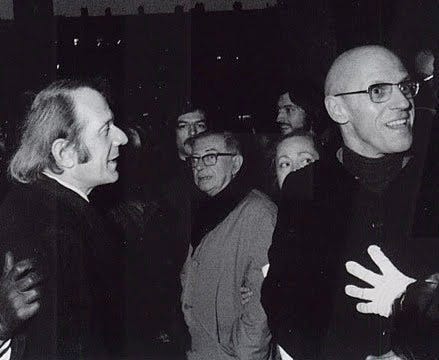
In his Preface to Anti-Oedipus, Foucault describes ‘the three adversaries’ of the text as 1) ‘those who would preserve the pure order of politics and political discourses’; 2) ‘psychoanalysts and semiologists of every sign and systems — who would subjugate the multiplicity of desire to the twofold law of structure and lack’; and 3) ‘the major enemy […] the fascism in us all, in our heads and in our everyday behavior, the fascism that causes us to love power, to desire the very thing that dominates and exploits us’ (A/A-ness, of Dream-Equality).⁶³ Foucault goes on to list ‘essential principles’ that can be extracted from D&G’s work; he writes:⁶⁴
1. ‘Free political action from all unitary and totalizing paranoia.
2. ‘Develop action, thought, and desires by proliferation, juxtaposition, and disjunction, and not by subdivision and pyramidal hierarchization.
3. ‘ […] Prefer what is positive and multiple, difference over uniformity, flows over unities, mobile arrangements over systems. Believe that what is productive is not sedentary but nomadic.
4. ‘Do not think that one has to be sad in order to be militant […] It is the connection of desire to reality (and not its retreat into the forms of representation) that possesses revolutionary force.
5. ‘Do not use thought to ground a political practice in Truth; nor political action to discredit, as mere speculation, a line of thought. Use political practice as an intensifier of thought, and analysis as a multiplier of the forms of domains for the intervention of political action.
6. ‘Do not demand of politics that it restore the ‘rights’ of the individuals […] The individual is the product of power. What is needed is to ‘de-individualize’ by means of multiplication and displacement, diverse combinations. The group must not be the organic bond uniting hierarchized individuals, but a constant generator of de-individualization.
7. ‘Do not become enamored of power.’⁶⁵
A remarkable list, one I believe the SCM expresses. Foucault ends his Preface with a description of D&G’s work:
‘The traps of Anti-Oedipus are those of humor: so many invitations to let oneself be put out, to take one’s leave of the text and slam the door shut. The book often leads one to believe it is all fun and games, when something essential is taking place, something of extreme seriousness: the tracking down of all varieties of fascism, from the enormous ones that surrounded and crush us to the petty ones that constitute the tyrannical bitterness of our everyday lives.’⁶⁶
Well written, but my concern has always been how D&G might devolve into chaos and “the loss of social intelligibility,” without which the average person will be overwhelmed by “existential instability” into desiring the very fascism which D&G worked to stop. Without the SCM, I don’t this irony can be avoided — D&G came too early, before the needed material infrastructure — but that will have to be explained. To do so, we will focus on a concept that has helped me grasp D&G anew. Admittedly, I do not feel equipped to elucidate D&G’s work well — for that, see Terence Blake — nevertheless, “transversality” has helped me understand D&G and relate them to the SCM (even if it is all a great misreading).
“Transversality” is a mathematical notion regarding intersection, but while something “tangential” touches on a single point and even “coincidentally” — if things are said to “be tangential,” we suggest their connection is not significant in some sense — what is “transversal” touches and makes contact in a very significant way without blurring and becoming identical. In a sense, what is “tangential” doesn’t really intersect, while what is “transversal” does, and it is this reality that deserves attention, for it defines the world far more than we often realize: everything around is “always already” a multiplicity. When I am emotionally stressed, there is a multitude of processes that occur simultaneously even if they are not identical, meaning the processes aren’t tangential but transversal: there is a biological reality (my heart rate increases), a psychological reality (my mind races), a social reality (my status could be at risk), and so on — Alexander Elung might call these “vectors.” It simply seems impossible to be stressed and not have all these processes occur at the same time, as it seems impossible for the phrase, “I am happy,” to be meaningful to others without it incorporating many dimensions and processes at once: we require the language, the sounds, the associating of smiling with a certain emotion, the possibility of spatial connection, and so on. What Deleuze and Guattari (D&G) want to stress is that these processes relate not coincidentally but much more necessarily, meaning it is this transversality that we should focus on versus each vector by itself (that biological, psychological, emotional, etc. processes occur together, not each independent of this simultaneous arising). Is there something like a “substance” between vectors making them act together? Well, in a sense, if “relations are real.”
In the past, I have thought about the epistemology of D&G as seeking “overlap” between worldviews, systems, etc., and though arguably a misunderstanding, I don’t think “overlap” and “transversality” are radically at odds: the idea of overlap was that if x appeared in System 1, 2, and 3, there would be reason to believe x was worth investigating. This is distinct from investigating System 1 or System 2 to realize internal consistency or something; when we look for “overlap,” we are looking for something that keeps manifesting in difference circumstances, meaning there is likely something to it (“overlap” can help us find something like “correspondence” without falling into a problematic “correspondence theory of truth” — but it also could be madness). Where there is “overlap,” x might transverse 1 and 2, meaning x participates in both without collapsing 1 into 2. In a world where we are susceptible to being “captured” by our “systems” and/or “maps,” seeking “overlap” and what “traverses” them can be a powerful tool to help us avoid enclosure. And in my view, the SCM could help us live and spread “an infrastructure of epistemological overlap,” which could help with “the problem of internally consistent systems” and other matters discussed in O.G. Rose.
For the first time, the SCM materially affords possibilities of “Deleuzian Ontoepistemology” to humanity. As an example, what are the chances that people who specialize on different thinkers will encounter each other and find “overlap” without regular encounters like what the SCM enables? Low, and even if specialists with overlap potential did encounter one another in the past, the likelihood they realized that potential due to “the introduction problem” was unlikely: it was too difficult to get “everyone up to speed” on average enough to make possible new associations, ideas, connections, etc. The “academic conference” sought to overcome these problems, the full potential for which the SCM can help realizes. (Is this why philosophy can feel like “it’s just getting started”?)
We’ll go into much greater detail later, but countless conversations are happening on the SCM, which is “a flow of multiplicity” that can interact not just tangentially but deeply: a single person can watch five different conversations, bringing them together within themselves. In the past, it was remarkably difficult to attend five different college lectures on five different thinkers, but now I can listen to one as I do my laundry, another as a fix a cabinet, and another just before bed (without spending much money): whereas in the past logistically and temporarily coordinating myself to attend each lecture would have been onerous and something I couldn’t do often (especially with work and kids), now it is far easier and something I can do daily. Furthermore, I can rewatch any of the lectures anytime, change the playback speed, pause, type notes — the ways I can interact with the material is far greater. I can leave comments which might start conversations, find people who want to discuss the material who themselves have uniquely “gathered up multiplicities” into themselves (affording “social network effects”), and more. The SCM also reduces the sheer manual labor of learning and research, making it much easier to achieve mastery and so realize deep “overlap” between fields, people, notions, etc. It’s also easier to find people with specialization who are willing to talk and engage across fields (not all specialists are), which the SCM affords while also reducing the logistical demands, making it easier to keep this engagement ongoing and developing. The fruits can also be recorded and shared with people who can enjoy them on their own time and in a way that matches their learning style, and if a viewer hears two experts say something the viewer doesn’t understand, the viewer can pause the video, go do some research, return back later, and so on. And there no grades, so people won’t feel judged for their learning speeds, styles, etc., or feel a need to justify themselves to others.
As helpful for handling diversity and making it relatable in Global Pluralism, for most of history, “the introduction problem” (as we’ll discuss) was too great for a critical mass of people to arise who could find “overlap” between their different interests, specialization, etc. at a deep level: connections and comparisons were possible, but they were often simple and tangential. Now, infrastructure is in place for more transversal connections between Heidegger and Hegel, Economics and Sociology, Language Game 1 and LG 2, etc. — a “Transversal Generalist” is now possible versus a “Tangential Generalist,” which profoundly enables Childhood and its spread in it affording us greater potential to make difference and “otherness” more relatable (and meaningfully so). In the past, if there were “overlaps” between Christianity and Hinduism (for example), which could afford connections and means of relations between the two religions, the likelihood of us realizing those connections or “overlaps” due to “the introduction problem” — which is generally the issue of having to learn enough about a thing to meaningfully discuss it — were low. Perhaps a scholar who dedicated years of work to the study could find them, but even if a scholar so succeeded, he’d have to go manually share his findings with others (he lacked recording and distribution technology), and how many people could that one person reach before the internet and easy access to videos and recording? Furthermore, it was a lot harder to get multiple people informed enough in both Hinduism and Christianity to discuss and debate the “overlaps” between them, and ideas need interaction to fully develop and be tested. It was harder to form a community around the potential connections, meaning that the connections could seem more imagined by some lone individual who wanted to see connections — it was far harder to form “plausibility structures” around new “overlaps.”
Also, if a scholar found connections between Christianity and Hinduism, what about between Atheism and Hinduism or Hayek and Kirk? It could take years to find, realize, and defend “overlap” between x and y that was significant and deep (transversal), let alone between x and z or x-informed-by-y and z (work which again could help make difference and “otherness” intelligible). The rate by which we “encountered otherness” has accelerated and is greater than what traditional education and scholarship could keep up with, and a result the “diversity” has mostly been to us unintelligible and overwhelming. Education with “overlaps” was not something we ourselves could easily participate in or know about unless we worked in or attended a university, meanings its resources for handling Global Pluralism were out of reach for most. But the SCM has changed everything, greatly accelerating and expanding the scope of scholarship, making it possible for us to not only find “overlaps” quicker and deeper, but to also spread and share those “overlaps” online to people who can now learn about them while doing laundry at forty with kids. This is the “lifelong learning” necessary for D&G’s political project and for Global Pluralism to avoid self-effacement: the problem has been that Global Pluralism arrived before did the SCM.
The problem of “tangential overlap,” of false connections, has been a significant problem in history, and so for good reason there has been a skepticism of “the connecting generalist” in favor of “the focused specialist” — but I would argue this follows from a lack of infrastructure, not some essential reality of learning and thinking. It is remarkably hard to find overlap in Difference that honors Difference without watering it down, and simply before the SCM we didn’t have the infrastructure to “connect well” on average; hence, we were not ready for the Global Pluralism (we brought on early). Also, before the SCM, we mostly had to decide to search for connections between things, say Hegel and Aristotle, versus “find ourselves surprised by grasping possible connections,” which makes a big difference and leads to “pre-framing problems.” If we look for connections, we might see things that aren’t there because we’ve primed ourselves to see them, but in the past, it was arguably impossible for us to be regularly and easily “surprised by connections,” due to the logistical demand and restraints. Might we just have happened to come across two people discussing Hegel and Aristotle? Sure, but that was unlikely, meaning we had to find and bring together those people, an effort which could make us invested and so wanting to find connections to make the time, energy, and money not feel wasted, reducing the chance that those connections were valid.
If we search for connections, we set the frame in which that search occurs, “framing out” possible connections from the start. But how could we put together an academic conference without using a “frame” that made that conference intelligible so that we could attract scholars, funding, etc.? We couldn’t, decreasing the probability of valuable “overlap,” meaning a better bet for putting together a conference would be to design it around specialists and specialization. Specialists discussing the details and fine points of their subjects aren’t so much at risk of seeing “false connections,” and everyone in attendance would also generally share a similar “language.” A conference which on the other hand brought people together of different specializations might put a bunch of people together in a room who don’t understand one another, especially not at a high level, and experts might not take kindly to being put in a situation where they felt like novices again (note also that the likelihood of realizing “valuable connections” can correlate with how much the people of different specializations personally like one another, which is hard to realize when dealing with Difference, and without an SCM this arrangement would be rare). And so the conference would likely fail, making such an effort irrational, and indeed, before the SCM such efforts were in a way irrational, but not because they were irrational, but because they needed infrastructure which was not yet present.
Now, of course, there is still searching online, but the likelihood of “stumbling upon something” or “overhearing something” is far higher. “Surprising connections” (which we are prepared for) are more reliable (though not always) than “planned connections,” but before the SCM there was no infrastructure that increased the likelihood of “surprising connections” for the average person: the closest we had was arguably the university system, where diverse people of diverse background could “surprisingly encounter” one another (and please note how much of an impact such spaces have had on the world, suggesting the potential of the SCM, which greatly enables such spaces). How exactly to “best realize surprising connections” is not obvious, but the SCM allows efforts, reconfigurations, and experiments that in the past were too onerous. An academic conference can take months to organize, but an SCM gathering can be every Thursday with people from all around the world for an hour before dinner.
Anyway, to return to D&G, though I don’t believe the point is misguided, nevertheless “overlap” is not a term D&G notably use (as far as I can tell). “Transversality” is more appropriate, a term which Guattari is the first to use in “Psychoanalysis and Transversality” that Deleuze later absorbs, and admittedly, the term is not used often by Deleuze, though I think its spirit permeates his work. As an example, the term appears in A Thousand Plateaus where he writes with Guattari (I’d suggest the whole section, “1837: Of The Refrain”):
‘[…] a distinction between matter and life, or rather, since there is only one matter, between two states, two tendencies of atomic matter […] Stating the distinction in the most general way, we could say that it is between stratified systems or systems of stratification on the one hand, and consistent self-consistent aggregates on the other. But the point is that consistency, far from being restricted to complex life forms, fully pertains even to the most elementary atoms and particles. There is a coded system of stratification whenever, horizontally, there are linear causalities between elements; and, vertically, hierarchies of order between groupings; and, holding it all together in depth, a succession of framing forms, each of which informs a substance in turn serves as a substance for another form. These causalities, hierarchies, and framings constitute a stratum, as well as the passage from one stratum to another, and the stratified combinations of the molecular and molar. On the other hand, we may speak of aggregates of consistency when instead of a regulated succession of forms-substances we are presented with consolidations of very heterogeneous elements, orders that have been short-circuited or even reverse causalities, and captures between materials and forces of a different nature: as if a machine phylum, a destratifying transversality, moved through elements, orders, forms, and substances, the molar and molecular, freeing a matter and tapping forces.’⁶⁷
More prominent concepts are “rhizomatic” and “(de)terrorization” in D&G, but I think these both relate and can be thought with “transversality.”68 Guattari’s use of the term “transversality” is not metaphysical like how it is in Deleuze, and yet nevertheless there is overlap with an orientation to “liberation” from over-terrorization. As Helen Palmer and Stanimir Panayotov put it:
‘Transversality begins for Guattari with the dismantling of the dual analytic relation between analyst/analysand in favour of a more collective psychotherapy. Rather than transference, which is the libidinal tie between analyst and analysand that allows for pathologies to be enacted and eventually cured, transversality opens previously closed avenues of movement and perception to produce an entirely new constitution of the institution or group. The degree of openness of these avenues is what Guattari calls the coefficient of transversality.’⁶⁹
“Transversality” enables movements and “flows” between all levels, coherences, and systems, and the greater the movement, the greater the potential for connections, surprises, emergences, etc. Guattari did not seek to erase organizational distinctions, but to make sure there were continual “flows” and movements between the organizational levels; that way, something new could emerge via transversality (though without the right infrastructure, say the SCM, all this would inevitably collapse). And this “transversal” could then hold the organization together, as metaphysically it is the “transversal” that a thing “is” (as a “(be)coming”) that makes it (itself). As Deleuze writes in A Thousand Plateaus:
‘What holds all the components together are transversals, and the transversal itself is only a component that has taken upon itself the specialized vector of deterritorialization. In effect, what holds an assemblage together is not the play of framing forms or linear causality, but, actually or potentially, its most deterritorialized component, a cutting edge of deterritorization.’⁷⁰
A notable expression by Deleuze of “transversality” can be found in Proust and Signs:
‘in a world reduced to a multiplicity of chaos, it is only the formal structure of the work of art, insofar as it does not refer to anything else, that can serve as a unity — afterwards […] But the whole problem is to know on what this formal structure rests and how it gives the parts and the style a unity that they would not have without it. Now, we have previously seen, in the most diverse directions, the importance of a transversal dimension, in Proust’s work: transversality. It is transversality that permits us, in the train, not to unify the viewpoints of a landscape, but to bring them into communication according to the landscape’s own dimension in its own dimension, whereas they remain noncommunicating according to their own dimension. It is the transversality that constitutes the singular unity and totality of the Méséglise Way and of the Guermantes Way, without suppressing their differences or distance […] Such is time, the dimension of the narrator, which has the power to be the whole of these parts without totalizing them, the unity of these parts without unifying them.’⁷¹ ⁷²
What are the philosophical and practical ramifications of this point? Well, to inquire into what “is” biology is not the same as looking into the simultaneous occurrences of biology, emotion, and socialization, and what D&G want to stress is that “sense” arises “between” and thanks to this co-occurring of heterogeneous processes (what D&G means by “transversality” perhaps relates with “the metaxological” of William Desmond). ‘What is signified is never sense itself,’ because “the sense” is “between” what can be signified, and there is “always already” multiple things that can be signified at the same time, meaning there is always opportunity for “making sense.”⁷³ Nothing would make sense if nothing occurred together, and there is nowhere where things don’t occur together, meaning there can be “sense” everywhere (and perhaps “where more occurs together,” like on the SCM, the more sense that is possible). And yet everything occurring together is not the same as each occurring “by” each: everything can make sense because everything is a multiplicity. And this seems empirical: to truly find a truly isolated process seems impossible. Math? Math is done in a physical world through a mind? When has math just “unfolded” with math?
As Deleuze puts it in The Logic of Sense, ‘the serial form is necessarily realized in the simultaneity of at least two series.’⁷⁴ What does this mean? By “serial form,” we can think of “a sequence,” and consider that a biological process follows a sequence of occurrences (“food is eaten; there is digestion; energy is gained”), as a chemical process follows a sequence (“alkene to alcohol to aldehyde”), and so on regarding Physics, Economics, Literature, etc. Especially for humans, what Deleuze is arguing is that no series occurs by itself: there is “always already” multiple series at once; to act as a human is to always act across vectors (if Biology is undergoing a sequence, so is Chemistry and Physics). ‘The serial form is thus essentially multi-serial,’ as Deleuze says, which means there is “a multiplicity unfolding together”: there is no “single series unfolding” or “isolated process” (which suggest how “relations could saturate into relata,” as Alex Ebert puts it).⁷⁵ And these series aren’t identical — ‘[t]he law governing two simultaneous series is that they are never equal’ — and yet series must be simultaneous to “make sense.”⁷⁶ Do things have to make sense to exist? Or do only things that make sense exist? That’s an important question, one we might have to consider another time with Hegel and things “dialectically unfolding” (which might not be as opposite to “transversality” as it can seem).
Deleuze writes that ‘when we extend the serial method — in order to consider two series of events […] — homogeneity is only apparent: it is always the case that one series has the role of the signifier, and the other the role of the signified, even if these roles are interchanged as we change points of view.’⁷⁷ Ultimately, ‘[t]here is an essential lack of correspondence,’ and yet even if a given series cannot be said to necessarily correspond with this or that, the reality two or more series arise together can be said to occur (there is “an event” versus “correspondence”).⁷⁸ I might not be able to say what “emotion is,” but I can say that the experience and actions of emotion occur with the biological processes that afford them, as those biological processes occur with the chemical processes that afford them, as those chemical processes occur with the physical processes that afford them, and so on (likewise, I might not be able to say that x idea is right on the SCM, but I can say x brought up and/or connected with y, etc.). What each of these vectors mean, and if it is possible for me to understand them alone, is what D&G suggests many intellectuals have mistakenly done for most of history. Instead, D&G wants to focus on the simultaneous occurrence of all these realities (“overlap”), focusing on connection and “situation” (alluding to Korzybski).
As far I can tell, there is a double meaning of the term “transversal” in D&G: it suggests “radical contact between processes, vectors, etc.” and at the same “that which traverses through processes, vectors, etc.” — an ambiguity I think is intentional so that D&G avoids suggesting there is an identifiable thing that crosses processes (the radical interaction generates “the thoroughness” between them: never does what emerges through them leave them behind). There is no stable “being” only “becoming,” and “transversality” seems to point to the reality that 1) there is always multiple processes occurring at once, and 2) “things” are “becomings” which emerge thanks to the deep interactions of the multiple processes. Since there are no “stable identities” in D&G, “transversality” must point both to the way the world “is/‘processes’ ” and that be identical with (the things in the world)/(how the world manifests). D&G are famous for the term “dividuals” versus “individuals,” and “transversality” means regarding people both “dividuals” and the world that affords “dividuals,” or else there will be a break between them that individuates. Is there no room for “individualization” in D&G? Well, it depends: the person can be a point where “flows” are fully realized, and in that sense we can “individualize” — and yet that is also a point in D&G where we no longer can identify the line between us and the world (like the schizophrenic, a loss of “AT Field,” per se): “the individual” hence “saturates” into “the dividual” (alluding to Ebert) — or self-effaces (both?).
Also, when there is “a surprising encounter,” there is more reason to believe that the processes which occur simultaneously must arise together (“transversal”): if the encounter is not surprising, there’s a chance someone or something coordinated them together somehow (say subconsciously) (“tangential”).⁷⁹ What occurs together when we aren’t expecting anything is that which is more likely to actually be together somehow (though not necessarily, hence a need for regular testing), and so an environment of “surprising encounter” is optimal for discerning the tangential from the transversal.⁸⁰ Describing “difference-in-itself,” the Early Deleuze makes the example of a lightning bolt, an example which can also help us think “transversality” and why it necessarily has a “surprising quality”; he writes:
‘The difference ‘between’ two things is only empirical, and the corresponding determinations are only extrinsic. However, instead of something distinguished from something else, imagine something which distinguishes itself — and yet that from which it distinguishes itself does not distinguish from it. Lighting, no example, distinguishes itself from the black sky but must also trail it behind, as though it were distinguishing itself from that which does not distinguish from it. It is as if the ground rose to the surface, without ceasing to be ground […] Difference is this state in which determination takes the form of unilateral distinction. We must therefore say that difference is made, or makes itself, as in the expression ‘make the difference.’ ’⁸¹
“Lighting” is “difference-in-itself,” arising distinct from the clouds thanks to various “processes” overlapping and really intersecting, and yet it isn’t reducible to those enabling conditions. It is “surprising” and unpredictable, which is evidence that we are dealing with something “transversal.” Similarly, looking to the SCM, when ideas arise together that were not planned to rise together “in surprising encounter,” there’s a better chance these ideas aren’t just tangential. When we plan to think Heidegger and Hegel together, our connections are more likely just tangential, but when we are prepared to think them together and “just find ourselves doing such,” there’s a better chance for transversality. Couldn’t the connections be false? Of course, but that the connections occurred indeed occurred, and that they occurred could be creative to discuss and think all the same. Even if we’re wrong about what we think is there, there could nevertheless be “something there.”
Is the transversal character of reality necessary? Until we experience a reality of isolated processes, I would say there’s no reason to think otherwise. We can’t have certainty, no, but “practical certainty,” yes, and so it is fair to live as if reality is transversal, and so as if what is transversal is real. If this is so, the more we can be “transversal,” the more we might be “like reality,” which there is a long history of philosophy and theology encouraging. The SCM can help us be “transversal,” which means it can help us be “more like reality” and ourselves. It is the infrastructure we have needed to “have being,” which ultimately in Hegel is “becoming,” and it turns out there is only “transversal becoming,” an “unfolding multiplicity together” — like Dante’s turning birds in Paradiso. The more we design social spaces that are transversal in character, the better the chance we’ll be like reality and so align with it. If the classical notion of “alignment with being is important” has truth, this matters. Furthermore, it is one thing for us to be transversal without knowing it, and another thing for us to live with our minds formed transversally, which is a matter of habits and so “spaces” we inhabit.
If reality is more transversal than tangential, then it is important we are “toward” reality as if it is such — and yet our institutions might have habituated us the opposite way. The division of school into specialties that only “tangentially touch,” for example, in helping form environments that then habituate us against the transversal (in a transversal reality), could be self-effacing. But the SCM could help correct this: it is a social infrastructure that gives the average person increasing access to environments where transversality can occur and be experienced. Though I don’t always use the language of “transversality,” I often discuss “surprise” and Encounterology, which we can associate with D&G in this way (and honestly this seems like another example where something that seemed new wasn’t so new after all). But is society really “against transversality” somehow? We’d seemingly only need a new social infrastructure if the society formed us “against transversality,” but does it? Perhaps much more in the past, before “the loss of givens,” but this is where D&G wants us to consider Capitalism and Schizophrenia, the latter of which I will capitalize to signify the ontological and metaphysical sense by which D&G mean it. For D&G, the schizophrenic patient is a revelation of Schizophrenic reality, which puts them at odds with ontological Lack suggested by Žižek and Lacan, but perhaps not as much as it would seem (or so I think and Terrence Blake argues, considering Lack could be a River-Hole). Capitalism works because it most embraces Schizophrenia without becoming schizophrenic, but how it succeeds in this can be problematic (and doomed to expire given economic stagnation).
II
Capitalism and Schizophrenia is a two volume set by D&G consisting of Anti-Oedipus and A Thousand Plateaus (or three volumes if we include What Is Philosophy?). We could consider Vol I as focusing on people in systems (lowercase schizophrenia), while Vol II is more focused on reality itself (what I’ll call uppercase-Schizophrenia). Again, Terence Blake is more equipped to explain these books than me, and I will speak very broadly, but it seems to me that Vol I is primarily trying to challenge psychoanalysis as a ruling paradigm for understanding people in favor of schizoanalysis, while Vol II then makes the step of arguing that this move is justified by, and alignment with, reality itself. The final paragraph of Anti-Oedipus frames well key differences between schizoanalysis and psychoanalysis:
‘What, finally, is the opposition between schizoanalysis and psychoanalysis, when the negative and positive tasks of schizoanalysis are taken as a whole? We constantly contrasted two sorts of unconscious or two interpretations of the unconscious: the one schizoanalytic, the other psychoanalytic; the one schizophrenic, the other neurotic-Oedipal […] We have seen how the negative task of schizoanalysis must be violent, brutal: defamiliarizing, de-oedipalizing, decastrating; undoing theater, dream, and fantasy; decoding, deterritorializing — a terrible curettage, a malevolent activity. But everything happens at the same time. For at the same time the process is liberated — the process of desiring-production, following its molecular lines of escape that already define the mechanic’s task of the schizoanalyst. And the lines of escape are still full molar or social investments at grips with the whole social field: so that the task of schizoanalysis is ultimately that of discovering for every case the nature of the libidinal investments of the social field, their possible internal conflicts, their relationships with the preconscious investments of the same field, their position conflicts with these — in short, the entire interplay of the desiring-machines and the repression of desire. Completing the process and not arresting it, not making it turn about in the void, not assigning it a goal. We’ll never go too far with the deterritorialization, the decoding of flows. For the new earth […] is not to be found in the neurotic or perverse reterritorializations that arrest the process or assign it goals; it is no more behind than ahead, it coincides with the completion of the process of desiring-production, this process that is always and already complete as it proceeds, and as long as it proceeds. It therefore remains for us to see how, effectively, simultaneously, these various tasks of schizoanalysis proceed.’⁸²
This paragraph helps deconstruct the notion that there is “pure positivity” in D&G — there’s room for negativity, as Dr. Blake stresses — as it also helps us see why D&G can lead to Accelerationism, as popularly associated with Nick Land. If reality is Schizophrenic, efforts to repress and deny this are arguably doomed (efforts D&G seem to associate with psychoanalysis), and since Capitalism is already “like Schizophrenia” socioeconomically, what we can do is simply intensify Capitalism to itself until commodification can no longer manage to “hold back” the “flows” and multiplicity, ‘[…] the process of desiring-production.’⁸³ This is the revolutionary potential in Capitalism that is Capitalism, possible in Capitalism fully realizing itself beyond commodification as Schizophrenic. What will happen? If we could say ahead of time, the result would be commodifiable: it must be “an event” that cannot be predictable before it occurs, or else it will only be appearance of revolution that serves the established.
To slow down and elaborate, D&G associate schizophrenia with a state where no associations, connections, “flows,” or the like can be denied: the schizophrenic subject finds themselves a pure multiplicity, saying “yes” to all of it. “Cat” rhymes with “hat,” so the schizophrenic must think of “hat”; the tree outside looks like the tree by the local grocery store, so the schizophrenic looks outside and discusses the local grocery store; and so on. Connections are reality: it is not so much that they are possibilities as they are “the case.” While most people might naturally experience the world “as if a collection of stable facts,” the schizophrenic more so experiences reality as “a multiplicity of flows” (“flows” replace “facts,” we might say), which for D&G is a subjectivity more like reality itself. In this way, the schizophrenic is unable to generate a map that isn’t “like” the (Schizophrenic) territory, which means the schizophrenic map is “too much like” what it represents, and so, in its accuracy, it proves unusable (like the Borges story shows). The schizophrenic map can’t differentiate itself from the territory of “flows” and multiplicity, and so it can’t be meaningfully said by the subject to be distinct from it. The subject and/or “map” hence dissolve, but in realizing this, D&G wants us to realize the truth of Capitalism versus treat the schizophrenic as “other” and outside consideration.
Schizophrenia is when “nothing is held back,” for D&G: all “flows” run unimpeded. Alluding to Part I, Capitalism is schizophrenic in that it “removes all givens” and hence liberates all “flows” and processes: sexuality is no longer regulated by religion, so can “flow” freely; social spaces are no longer regulated by social etiquette, so the desires of people can “flow” in social spaces as they want; events like baseball games are no longer regulated by traditions where say the rich and poor both watch the game from the same bleachers (an example Michael Sandel makes in his book What Money Can’t Buy), and so money and capital and “flow” more freely into baseball; and so on. Capitalism wants access to every possible “flow,” because “flows” are endlessly productive (moved by their own movement) for the system, and so Capital removes “the givens” that keep it from accessing (endless) “flows”; once those are accessed, Capital then keeps those “flows” from overwhelming us by training us into “the metajudgment” of commodification.
For D&G, Capitalism works well as schizophrenic for it is the system most like reality as Schizophrenic. Reality is “ontologically Schizophrenic,” and so is Capitalism, but Capitalism manages to stabilize and contain the “ontological Schizophrenia” through commodification. There are countless, unstoppable flows and processes, but by spreading “the metajudgment” of commodification (“the equal sign,” exchangeability, A/A, etc.), the system is able to make reality “manageable, ”but do notice the double meaning of that term: Capitalism makes us able to handle multiplicity (as if all the same in commodification), but it also makes us something the system can handle. A problem D&G had with Capitalism is both that it made us “capturable,” and that it denied its schizophrenic core, which lead to it oppressing those who were schizophrenic and unveiled the quality of the system to itself. This was a great injustice and arguably unsustainable: it meant the system operated necessarily by power and oppression, and it also denied us the opportunity to see what the world would be like that deeply embraced multiplicity. To make Capitalism experience itself, D&G emphasized increasing and proliferating “intensities,” but how this is done matters. Is it done alongside a multiplicity of value-forms and metajudgments (as enabled by the SCM)? If not, self-effacement might spread.
Capitalism trains us into a metajudgment of A/A that makes Capitalism function, but Capitalism also unleashes “flows” from “givens” in order to create (ever-flowing) new markets and extend old ones. Capitalism seeks to “hold nothing back,” but at the same time it funnels everything through commodification so that we are not overwhelmed. The subtle difference between the schizophrenic subject and Capitalism as schizophrenic is that while the subject lacks a way to contain and direct the “flows,” Capitalism is in a sense not “totally schizophrenic” in that it can still manage the “flows” via commodification. We earlier in II.2 discussed “the metajudgment,” and what we can say is that Capitalism unleashes all possible “flows” (extending markets) precisely so that they are not protected from the commodification that at the same time protects us from those “flows.” In the A/A-metajudgment, the multiplicity all “equal” in exchangeability (A/A), and so the multiplicity doesn’t overwhelm us: we toy with Lovecraft and live (for now). And since we find “the understanding of commodification” pleasurable (as discussed in II.1), we happily engage in the work of managing the multiplicity via commodification in favor of markets, especially as Global Pluralism intensifies: the work of commodification saves us from this displeasure of anxiety.
How is D&G’s schizoanalysis distinct from Lacan? Whereas psychoanalysis generally wants to emphasis Capitalism as a system that uses our “lack” against us, in the sense that it promises us goods that will “fill our lack” though they never do, keeping the system ever-going, D&G wants to instead argue that there is an ontological reality of “flows” and multiplicity that are ever-going already, and that what Capitalism does is simply “tap into” and direct those ever-flow(s) to the point where we as consumers become like schizophrenics and cannot stop them, yet at the same time Capitalism trains us into “the metajudgment of commodification” so that these “flows” don’t overwhelm us like they do the actual schizophrenic. For D&G, these “flows” are actively productive and generative, and so Capitalism can develop and grow by employing them in its favor, versus the growth of Capitalism be due to a psychoanalytical “lack” that we are trying to overcome, and our efforts to overcome “lack” be what generate the system and economy. Since these “flows” produce (for good and for bad), Capitalism can increase its productivity by increasing the movement of these “flows,” hence why it erases “givens” that hold Capital back. But this risks making us schizophrenic, as following Rieff “the loss of givens” will cause existential instability which makes totalitarianism appealing. Are “existential instability” and “D&G schizophrenia” identical? There are differences, but I do think they overlap and that the risk of “growing schizophrenia” is indeed a growing likelihood of being controlled: “the loss of givens” can lead to the rising of “a strong man” or an AI which can manage us as we lose the capacity for self-determination in a kind of schizophrenia (it’s likely Rieff and D&G simultaneously).
For D&G, Capitalism unleashes “a multiplicity of flows” from restrictions and “givens” while at the same time training us into commodification (A/A) to not be overwhelmed by that multiplicity, while for Lacan, Capitalism takes advantage of our “essential lack” with promises of fulfilling our “lack” away, while at the same time training us into commodification to find that promise intelligible, plausible, and something only the market can provide. The political project of liberation for Lacan can be found in “integrating with lack,” while for D&G it is found in accelerating the spread and multiplicity of “flows” until Capitalism can no longer deny it is fundamentally schizophrenic, opening up new possibilities. Neither schizoanalysis or psychoanalysis can say exactly what might happen thanks to their revolutionary activity, but both also make the point that if they could the revolutionary would be too neurotic, “top down,” and likely already commodified, so their lack of a clear prediction is understandable. Nevertheless, both require a significant risk, and history is full of examples of people trying to make the world a better place who as a result make it worse. Couldn’t both of these efforts repeat this mistake? Yes, but the SCM could help with the benefits without the negatives.
It’s another subject that deserves a book to unpack, but Žižek and his views on “quantum history,” which entail an “essential lack,” can be contrasted with D&G, who favor “fundamental multiplicity.” With Blake, I personally think these positions can be thought together, but it’s still the case that there is a tension that should be honored. Still, I think both of them ultimately point to a need for the SCM (and both can serve Dream-Equality), so regardless which is ultimately right, I think there is “reason to think” we should focus on the development of the SCM. To elaborate:
1. There is “an essential lack” that we need to realize, face, and be habituated to handle.
2. Or there is “an essential multiplicity” that we need to unleash, experience, and be habituated to handle.
3. The SCM trains us in Encounterology, A/B, “handling Otherness,” which are qualities both of “encountering lacking” and/or “encountering multiplicity”
4. Therefore, with psychoanalysis or schizoanalysis, we need an SCM.
In II.1 we discussed how working to “spread Childhood” is worth doing even if ultimately “a new address” is impossible, precisely because the subject and person benefit; similarly, we are suggesting that regardless if Žižek or D&G are right, the SCM is wise to employ. This isn’t to say the debate between Žižek or D&G doesn’t matter — it matters a lot — but that we can focus on the SCM before that debate is fully resolved. My personal leaning is toward Žižek, but over the years I find myself appreciating D&G, despite how much I was initially repulsed (Terence Blake is an invaluable trailblazer).
D&G seem to want to emphasize how Capitalism controls us via a “funneling of flows” (into A/A) versus what we see in psychoanalysis where Capitalism works by helping us “deny our lack” (as not fundamental). Perhaps D&G would say that the whole point of Capitalism is to “unleash flows” to a degree we cannot handle so that we must cling to the commodity-form (A/A) that benefits Capitalism to avoid self-effacement? That’s fair, but regardless the idea is that reality is a collection of constant flows, a great multiplicity, but Capitalism habituates us into A/A-being precisely so that this multiplicity doesn’t overwhelm us. If Capitalism is failing though, then far from a liberation, this could prove Lovecraftian; nevertheless, if to the degree we can handle “schizophrenia” is to the degree we can “spread Childlikeness,” “create demand,” etc., this is a risk we must take. In my view, our only hope would be a new way to stabilize the flows, and this is the hope of the SCM.
D&G suggest revolutionary potential in accelerating and spreading Capitalism precisely to the point where it can no longer handle the “flows” which it has unleashed: if it removes social etiquette at baseball games in favor of market opportunities but doesn’t also deconstruct gender boundaries, the revolutionist of D&G would favor deconstructing gender boundaries. Not necessarily because the revolutionist is so much against gender or the like, but because gender at this point would be keeping Capitalism from “seeing itself to itself,” helping it maintain “plausible deniability” of what it does and how it functions. Is that the right move? Maybe or maybe not, but my point here is to highlight why D&G favor a radical release and expression of “flows”: it is for the sake not so much of individual expression or freedom, but for unveiling Capitalism to itself to change “the conditions of possibility” of what our world might realize.
The revolutionary act in Capitalism that is Capitalistic can be for D&G to say that not even “human” is a fixed category, affording us the space to “become animal” not in a sense of imitation but in embracing energies and “flows” that free us from fixity into new social formations like a wolf pack that co-creates both the wolf and the pack (though until the SCM, I don’t think this was possible without chaos). This might seem absurd, and certainly it threatens social intelligibility, but that’s also the revolutionary point: for people to free themselves from rigid categories and identifications is to force Capitalism to see what it is doing — all “plausible deniability” is lost. I don’t think D&G are entirely wrong, but whereas they would want to accelerate the “unleashing of flows” to intensify the schizophrenic multiplicity of the system (that aligns with Schizophrenic reality), I would want to instead accelerate the spread of different metajudgments and Value-Form Competition. Indeed, there’s a sense in which I favor accelerating Capitalism like D&G suggest, but that instead of “unleashing flows” I want to spread and multiply metajudgments and value-forms. Is that really “accelerating Capitalism,” though? If Marx is right that Capitalism trains us into metajudgments and value-forms to make itself possible (as we discussed with “The Situation of Capital”), I think so, but instead of just unleashing “flows” thanks to and (in)to commodification, we are focused on generating “a multiplicity of values,” or otherwise we will suffer self-effacement before “the loss of givens” and “unleashing of flows” (Lovecraft). I personally don’t think we can be trained and habituated into new metajudgments without “facing lack,” hence why D&G and Lacan must be thought together, at the very least because we have to face our “lack of capacity” to handle “too much multiplicity” and/or “too much Otherness” at once. Can we improve and learn to handle more? I think so, but the work is never finished: there will always be “lack,” but that is also why there can always be “intrinsic motivation” — life.
Anyway, Capitalism trains subjectivity to “funnel” all the “flows” into the commodity (A/A), hence why “the multiplicity” (A/B) doesn’t destroy us (for good and for bad). As we learn from Marx, the problem is that we are habituated and “enclosed” into A/A-thinking, and as a result we can only “metajudge” reality according to exchangeability and the commodity-form. We are not diverse enough in our values and discernment, and in my view, if we “intensify flows” without also training and diversifying metajudgments and value-forms, we’ll be self-effaced. The hope might be that intensification of “flows” would force us to diversify our metajudgments to survive, but I’m not sure in that situation if we would be able to think that we needed to diversify our metajudgments versus buckle-down and intensifying our (doomed) efforts of commodification: if we are habituated into A/A but the consequences of A/A become unsustainable, I would not bet that this difficulty would lead to us considering A/B, for A/B might not be something we could even think. I don’t blame D&G for this emphasis on “intensifying and spreading flows” though, for they lived in an age before the SCM: what we are considering was not yet possible, lacking material infrastructure. But again, I believe D&G through “the multiplicity of flows” without “the multiplication of metajudgments” ironically ends up creating conditions that favor the fascism which they worked to stop.
Much more needs to be said to fully unpack D&G and compare them with Lacan: our point here is only to suggest that rather schizoanalysis, psychoanalysis, or a combination of both is right, a focus on developing the SCM is wise. Today, our choice is between a “Transversal SCM” that cultivates Attention against Affliction or “Schizophrenic Internet” that destroys Attention to cause Affliction (and the clock ticks). As we considered with Lorenzo’s work in II.1, I believe D&G point us to neurodiversity and mentidivergence (as we discussed with Simone Weil), which gives us the liberating potential of “transversing.” The SCM enables us to possibly stabilize multiplicity to us via metajudgment without, to itself, reducing its diversity and “flows” (helping us avoid schizophrenia without denying Schizophrenia). While Capitalism stabilized ontological Schizophrenia with the metajudgment of commodification, the SCM endeavors to ever-“catch and release” Schizophrenia through multiple metajudgments and value-forms (unmeditated Schizophrenia is Lovecraftian). Looking ahead, for D&G, the world arises from “crossings to structures,” not “structures to crossings”: the paths, “between spaces,” “roads,” and the like come first. Why does this matter? Because it provides a metaphysical and ontoepistemological foundation by which to approach works like that of Josephine Quinn (for example), who argues that the Silk Roads were just foundational as the civilizations which it connected. If this is so, there is more reason to believe the SCM could be a prime movement in “the new address.”
If everything is “flows,” then we need an infrastructure that enables and can manage “flows,” and that is what we have in the SCM (in which managing we might “create demand” versus just stimulate it, negate/sublate desire into drive, and other matters discussed in II.1.) “Transversal Connection” might also be thought of as “a new mode of exchange” and relating, alluding back to Karatani (D&G could point to “Mode D”). “Overlap” is when x and y form a connection with one another, and in that sense “exchange something” between them, and yet this is an exchange where both parties get to keep what they brought to the exchange, and both parties get to equally enjoy and partake in the gains. Neither x nor y have power over the other, nor does x or y have to “reduce” the other to understand and desire what is brought (like the commodity can train our metajudgment in its favor). “Overlap” is like the gift (Mode A), might “enable” one another (Illich) to deal with unknowns without direct protection (Mode B), and both sides feel to equally gain (Mode C). The “overlap” of the SCM could be more like “a voluntary association,” an exchange that is more like sharing and gifting beyond family that is Non-Zero Sum (Mode D) (a matter of spread versus just scale).
Alright, this all sounds nice, but why should we think the SCM could accomplish so much? In addition to metaphysical justifications, we have examples from history that help make the case. To begin that consideration, which I believe aligns with D&G, we will eventually examine the work of Lene Andersen and the Nordic Bildung, an education of the generalist, “flows,” exchange, and realizing fully humanity (which also suggests German Idealism and D&G are not as opposed as often thought). What Lene Andersen describes shares a spirit with the SCM, and this could also be an alignment of our system and material condition with “the learning universe” described by Brendan Graham Dempsey in his series titled, The Evolution of Meaning, which could also provide a cosmological reason to believe the SCM is “like reality” and so more likely to work. But what exactly — to use language more aligned with Dempsey — might the universe, say in us, be trying to teach itself about itself? Perhaps the art of handling its Multiplicity, which requires “integrating with Lack” (say as what enables the possibility of handling Multiplicity)? Multiplicity could define the universe, but the universe in us at this point only knows how to “be” a Multiplicity; it doesn’t know how to “be conscious” of itself as a Multiplicity and that not overwhelm it, in the sense that the awareness requires too much energy (it is too entropic without negentropic potential, as Paul Krafel discusses). The universe has not taught itself how to be conscious of itself in its fullness, but this seems impossible, because minds are finite, and even if it was “theoretically possible” for us to use rationality to learn the fullness of reality, this would be “practically impossible,” because the energy demands would be too high and/or we’d run out of time before we died, but even if somehow one person could do this, this awareness would likely not be shared by significant numbers to afford “social network effects” to enable profound creativity and thought. Could AI do this work? It might help, but if there is something about “knowing fully” and “going through the process of learning” that cannot be separated, then we must do this work and undergo this process: AI cannot do this for us. What if AI replaces us and the universe follows AI to learn about itself? That seems to be the question before our AI-Causer…
The universe requires not just more thinking but a different kind of thinking (for the majority versus random individuals), that’s potential is latent in itself, if the universe is to become conscious and aware of its Multiplicity in its fullness without being overwhelmed. Regardless the use and importance, calculation and rationality cannot overcome its entropic limitations, even if they played an essential role to get the universe/us to this point; a different kind of thinking is needed, one we can associate with “The Right Brain” of McGilchrist, “The Gestalt Theory” of Jan Zwicky, and “apprehension” that I associate with Sam Green’s work (even Pierce’s “abduction” and Bergson’s “intuition”), all of which requires Attention to be possible. Classical thinkers like Plato understood that we seek to witness form, not just think it — thought thinks to witness — and a kind of “witnessing” seem to be to what these thinkers point.
What exactly is the capacity that the SCM can train and incubate us into which can add Value-Form Diversity to the world? “Apprehension,” notably. The only way we can realize the Schizophrenic quality of reality, its great Multiplicity (that could also be apophatic somehow), without being overwhelmed (into schizophrenia) is via what Jan Zwicky calls “insight” or what I have called with Sam Green “apprehension.” If we don’t have this capacity or can’t increase the conditions of possibility where we might develop it for a critical mass of people (say through “aesthetics” and “an incubating architecture”), then we will be stuck in calculation and rationality, and either the Multiplicity will overwhelm us or AI will replace us. The energy demands of calculation are high, but I think apprehension “grasps” instantly and even creates negentropy — this is our hope. The Multiplicity without calculation can be “apprehended” into a Gestalt (“form-ulated”) that doesn’t violate the Multiplicity (“top-down”) but is actually in the Multiplicity and possible thanks to it: the Gestalt is Transversal, perhaps like the “lightning bolt” Deleuze described. And where there is only calculation without apprehension, the rational without nonrational, we will feel “pulled along,” Kafkalike toward a Rational Impasse. And, to make an assertion, whatever we “gather” in our lives will feel dead if, in its presence, we never experience an “apprehension” or “insight” — that is the qualitative experience that can mark a difference between “a gathering” and “a collection,” a living vs a fragmentation.
Is the Gestalt just some “illusionary effect” or indication of Deeper Being? That could be a question of the Final Absolute Choice; here, we only need to establish that “apprehending gestalt(s)” in Multiplicity is necessary for Multiplicity — Global Pluralism — not to overwhelm us. It is this capacity that the SCM is primarily and uniquely positioned to train us in, for it “gathers” greater diversities into a container and space where “apprehension” might surprise us suddenly and all at once, as if “always already.” But now we must explain.
III
In “The Net (138),” we discussed how knowing we have a high IQ can make us fragile (as perhaps being told we are diverse makes us less able to handle Pluralism), how the terms “genius,” “skilled,” and “elite” need to be defined apart (I prefer “skilled” and the word “elite” in the context of skill), how “the teacher trivia(lizes)” while “the tutor frees speech,” how genius without vulnerability/nakedness is dangerous and likely to lead to the (autocannibalistic) “barbarism of refinement” (Vico), while humbled genius can be like the fish who realizes he or she is in water (“a metajudgment”) and thus move toward real, architectural insight that can incubate profound latent potential — which suggests the great mistake of associating genius with avoiding nakedness and vulnerability, supercharging “the barbarism of refinement.” We also discussed how we are trained in school to think “help” is “cheating” and so we are setup to avoid “(falsely) offered help” when we need it, while the real world consists of tasks that can’t be done alone, helping us not associate “help” with “weakness” but realism. It was a fun time.
Anyway, a point of that session I want to draw attention to is when Jurij Jukic discussed Michael Levin and the work Levin has done in Morphogenesis, Bioelectric Signaling Networks, and Collective Cellular Intelligence. Levin has shown that cells don’t just blindly follow genetic determinations but prove more active in solving problems. Now, I don’t think Levin would say different environments generate “new” information in cells, but instead constraints lead to cells finding new ways to reach the same goals: if for some reason they can’t form an eye like they normally do, they’ll find a way to form an eye in a different place (which in one sense is new, but in another is not). To at least make an analogical connection, it’s reasonable then to think that different environments could bring out different potential latent in human beings (that is at least “relatively new” to us). Where there is a lack of diverse environments, and where we lack an environment like the SCM, it is reasonable to wonder if there is potential in humans that has never fully manifest (at “a critical mass”). Also, though cells simply find new ways to realize the same goals, perhaps the goals humans have latent potential to realize change-without-changing based on how humans go about realizing them (a case perhaps unique to Mind)? Say our goal is “to be fully human,” which we’ll all find a way to accomplish given our environments and constraints — what if what it means to be “fully human” is uniquely indivisible from our constraints (this may or may not overlap with “teleology,” though I think Levin resists that language)? Our goal to “be human” doesn’t change, and yet what that means also does change based on our constraints (“changing-without-changing” might be a unique quality of the metaphysical) — might that be the case? Only one way to find out: do the work of diversifying environments, constraints, “limits” (Ebert), design for Encounterology…
We have spoken of architecture, mediums, environments, and metaaesthetics in O.G. Rose, and how the formation of things cannot be considered independent of the spaces in which they are situated: Levin seems to provide evidence for this case. In different environments, different “intelligences” show up, and if this is the case, then cultivating different modes of consciousness and greater “inner capacity” will not readily be accomplished by giving people more information or emphasizing different modes of thinking (“an emphasis shift” is not “an architectural shift”: if we start championing EQ within the same structure or design, there will be a change but not a change in kind; a change in emphasis cannot change how latent potential manifests, only a change in design). “The Nordic Bildung” seems to have realized this, as did Neil Postman in applying McLuhan’s famous “the medium is the message” to school itself. And if our problem amidst Multiplicity is mainly a lack of a capacity like “apprehension,” spreading this capacity will not be done so much through information but architecture. Yes, Levin notes “flows of information” matter, but increasing “flows” (Deleuze) is a matter of design. To play off Lewis like I often do, if we focus on architecture, we can get information as well (“meaningfully”), but if we focus just on information, it’s as if we get neither.
The SCM affords the creation of and coordination to new and different environments, “aesthetics,” and/or “medium conditions” (elaborated on in II.3), and Levin suggests that is critical if we are to achieve and realize the mentidivergence we associated with Simone Weil in II.1 and that we claimed was necessary for avoiding Game Theory problems like Nash Equilibria and Rational Impasses. I personally am shocked by the capacities that can come out of me in different environments (the different “me(s)” I can be): when I worked in a floral wholesale, I could remember the names of hundreds of flowers, which I would have never thought possible. I don’t think modern education takes this reality seriously enough: if it did, instead of just emphasizing different kinds of thinking or giving students more information, it would try moving kids through different environments and designs. Is this logistically possible? Perhaps not, so the mistake was historically reasonable, but now we have the SCM, and that could open doors. Also important, the SCM could help us continually experiment and try different environments, conversation-technologies, models of interaction, etc., which is extremely important because we don’t know which environments are best for which latent potentials at which times — a point that brings to mind Jonthan Rauch again in Kindly Inquisitors. The SCM throws us into unknown possibilities with unknown people with unknown ideas and models — exactly the “curated surprise” we need to realize latent potentials we don’t know how best to realize. Constant and continual social experimentation matters, but until the SCM are means for doing that we’re radically limited, handicapped by economics, time of life, geography, etc. That has changed: previous methods of social coordination like IQ tests, college credentials, or resumes are outdated.
The Bildung-20 affords new ways of thinking (“mentidivergence”) via environmental incubation and habituation, but what does this mean? To incorporate a literary analysis, “The Mermaid” by Sam Green points to unique uses of subjectivity that the SCM can train, opening possibilities of “speculative reason” that we cannot predict or limit. Sam focuses on masculine and feminine differences in her story, which we unpacked in Ep #211, and, as we discussed, “the ocean” in her work is feminine and what we can associate with the SCM: “traveling the philosophical silk road” can be like “going into the waters” of Sam’s story. It is an “apophatic void,” a possible “River-Hole” (Cadell Last): it is dangerous and unpredictable, and so it can heal and personally develop. Also, in Vervaeke’s “Dialogos,” people often find themselves discussing ideas they didn’t predict or ever think before, which is “an association of and by nothingness” that makes possible “personal development” — another important idea considered by Sam (that we can associate with literature more broadly). The full review of “The Mermaid” can be found in Third Thoughts; here, I wanted to touched on some of the ideas that are relevant for our purposes here. From the review:
‘[…] everything that is said on ‘masculinity’ and ‘femininity’ are generalities that do not apply to everyone, for everyone seems to be a mixture of both to some degree that no one can judge for certain. Feminine logic associates and gathers to make a whole that a truth can be apprehend in, while masculine logic calculates and uses rationality to make a conclusion of a truth. To better understand feminine logic, imagine one of those pictures that are made of a lot of small pictures, which are put together in such a way that a large picture can suddenly be seen (from A Philosophy of Glimpses, consider the FedEx Sign that we can look at and suddenly see a negative arrow that was ‘always already’ there and yet easy to miss). As Sam noted, we can think of the female as verbally processing and telling everything that happened in their day in order to gather a collection of images, a whole, that ‘suddenly and all at once’ a truth can be apprehended in and from — it is an aesthetic and artistic act. Like making a FedEx sign, the feminine can do the same in gathering details, describing scenes, acknowledge emotions — all of this can be like gathering little images that put together, bit by bit, in hopes of suddenly and all at once there being a whole (‘a big picture,’ ‘Find What the Sailor Has Hidden’ in Nabokov) in which a truth is apprehended. The woman is gathering things ‘into nothing’ for most of the time, without any clear reason, and then ‘suddenly and all at once’ in the nothing there is a reason (‘suddenly and all at once’ there is the apophatic). The woman is making a void. And then suddenly that void smells like tulips.
‘ ‘Masculine logic’ does not so gather everything: it discerns what is relevant, narrows to save time and energy, and considers the relevant factors together into a relevant conclusion. It is much more efficient, for good and for bad, because if there was a ‘apprehensible truth’ in the variables with which the male worked, the male could miss it, because he would not gather all the variables together as necessary for apprehension and instead leave most behind […]’
The review discusses how the risk of feminine logic can be the conspiracy and seeing connections that aren’t there (“false gestalts,” as Zwicky puts it), while masculine logic can end up in reductionism and “autonomous rationality” that proves dangerous. Feminine logic entails an apprehension that happens mysteriously: when it will occur cannot be predicted or sequentially laid out, no more than we can predict the moment when someone can look at a FedEx sign and suddenly “see” the “negative space arrow” that was “always already” there. This in mind, please note again how often people in the SCM speaking of “saying things they never thought before” in the middle of a Dialogos. Is this a conclusion? Yes/no, it is a feminine apprehension (feeling like “a gift from the cosmos”), and arguably great “wealth creation” starts from this kind of act (discussed in II.1). Regardless, the implication is that the SCM is a place of “gathering” for the possibility of “apprehension” more than just “calculating to a conclusion.” That is why it is the case that “why it works” is mysterious and hard to explain, but it’s a mistake to conflate “hard to explain” with “fake.”
We cannot calculate our way to see the FedEx Arrow, only position ourselves to it to change the relation (a truth suggesting freedom). We also can’t calculate our way to “the truth” because we would “slice it up” along the way into something it wasn’t: it must be apprehended as a whole or it will be something else. And there’s reason to think everything is possibly like the FedEx Arrow, seeing as a poet and artist can “apprehend” a creation from any phenomenon (“a moment of inspiration”). Everything can be apprehended (there is endless material for the SCM), but everything in its fullness is like nothing. That is the challenge. And is the apprehension a result of causation? It involves causes, yes, but no cause can be called “the definitive cause,” which is to say that which necessarily would lead to apprehension. The moment is one of creation, like associations, which are linked not by causes and effects but by persons. We are transformed by associational connections more than causes, and we can’t will an association: they just happen, though we can stop them, seeing them as a waste of time…
Sam in her story associates the feminine with “the (apophatic, terrifying) void,” and what she means by this is elaborated on in the review. A critical point is that:
‘[i]t is in the void where it is possible to experience a personal development that must be a ‘personal development,’ for the associational logic that ‘unfolds’ cannot be attributed to anything outside the person; after all, in the void, there’s nothing there (just us).’
Likewise, as we’ve discussed throughout II.1, it is before Lack and “The River-Hole” that the same can be claimed: the personal must be here. The SCM, like literature and the humanities, is a space of associational and emergent possibility, and so it must be “personal development,” and better yet we really experience it as such. We feel ourselves change in the journey. We know that in the nothing was something, us, “always already” anew.
The “apprehension” that Sam Green describes through her short story “The Mermaid” aligns with the “insight” and work of the incredible Jan Zwicky, who defends “Gestalt Theory” against reductionism. I cannot suggest her lecture “The Experience of Meaning” (2013) enough: she is a profound and eloquent forerunner of much of the thinking that now defines the SCM. Zwicky tells us that we seek flashes of “insight (of Gestalt)” more than linguistic understandings, which is to say we seek and long for “strikes of Gestalt” (like “strikes of beauty”), which are the experience we seek when we seek meaning in our lives (or so is the claim). How might we think of these “strikes”? To take from her masterful book, The Experience of Meaning: ‘[f]or the experience of meaning — ‘getting it’ — is the gestalt phenomenon par excellence.’⁸⁴ We all know the experience of suddenly “getting it,” of reading a poem over and over again, of wrestling with a math problem, of listening to a lecture — and suddenly we “get it.” We comprehend. Why we comprehend now, at this moment, and not five minutes ago, is impossible to say, but we can tell the qualitative difference. Thomas Jockin has made the point at “The Net” that professors never know why or when “learning happens,” a point I align with Zwicky and that suggests “learning” is “getting it,” and so what Zwicky discusses is at the very foundation of what makes learning possible. And yet we hardly notice or think much of it, treating that moment of learning as not qualitatively distinct from the studying or calculation of a math problem or book that preceded it. ‘Underlying [our world], at its root, lies a particular conception of thinking — thinking as calculation — which has itself eroded our ability to see its limitations’ (as Kafkalikeness as made Voicecraft invisible to us).⁸⁵ We are so habituated to the experience of using calculation and rationality to solve our problems, that other ways and experiences of thinking are concealed from us, like untrained wine-tasters who can’t tell, or lose the ability to tell, the subtle differences between flavors.
Sure, there is working through “3 + 5” to conclude “8,” which doesn’t really entail much “getting it,” but that experience of reaching an answer is not the same qualitatively as staring at FedEx sign until we see the negative arrow or Zermelo working through a great problem like Russell’s Paradox until one day “getting it.” Well, perhaps it is on the same gradient somehow, but grasping what Zwicky is “getting at” is easier if we think of a great problem we don’t know the answer to, wrestle with for months, and then suddenly “see” the way forward (note this experience can often feel like “seeing it,” suddenly and all at once, pointing back to Plato). And when we “see it,” it’s hard to describe why “it is it” — to give an adequate “because” — but that’s what we should expect when it comes to that which must be “seen” (and that bringing into words changes, like writing down music we hear into sheet music); Zwicky captures this predicament well:
‘In many contexts, the right answer to the question Why did that viola just emit as F-natural? isn’t Because its C-string was stopped at the ratio 4:3; nor is it Because that’s how Beethoven’s Third goes. Or, as Aristotle might say, you don’t have an explanation until you’ve grasped the formal cause; a thing’s form is what it is.’⁸⁶
And when we do “get it,” there can be a fascinating feeling of experiencing something beyond our agency (“a freedom in determination,” as we discuss with Hegel, which I think is needed for us to feel “meaning” versus something arbitrary); Zwicky writes: ‘I can attest from personal experience that when an ensemble is ‘cooking’ or ‘in the groove,’ it feels, to the musicians, as if the music is playing them.’⁸⁷ What is experienced is not simply reducible to the choices and wants of the people involved: something “other” is experienced (A/B).

Zwicky argues that even the most adamant of analytical philosophers can’t avoid ultimately relying on some “getting it,” even if their work is devoted to making all claims expressible and justifiable:
‘After an attempt to ‘outline roughly’ what he means by ‘true,’ Frege concludes that ‘it is probable that the content of the word ‘true’ is unique and unidentifiable.’ He can’t explain further. You either get what he’s driving at, or you don’t.’⁸⁸
“Apprehension” will always be smuggled in somehow (though not all “smuggling” is equal), but with time we can lose the “refined epistemological palette” to tell its employment. And what happens in this employment? We “grasp a whole”? Yes, for when we grasp what the word “true” means, we are grasping an array of relations and uses with and in a whole world. We never grasp just “a point,” but a whole situation and network of causes, effects, influences, functions, and the like. To say something is “true” means that it behaves a certain way in relation to other ways and other things, which means we can reasonably expect certain behaviors, tendencies, qualities — or perhaps it means we expect to be able to share the notion with others without them disagreeing with our conclusions, and so on. What we “grasp” when we say “x is true” is based on memories and experiences in our world — a whole lot of things based on lived experiences (bringing Saul Kripke to mind). But funny enough we don’t so much “think about all that” but instead “just get it” when the word “truth” come up; now, we can of course stop and question that “getting it,” which Zwicky notes can be important so we avoid “false gestalts” and I would say “false apprehensions,” meaning nonrationality needs rationality, but the point here is that this mental activity occurs at all, and that which occurs is distinct from calculation and rationality. The wines are different, even if identifying the difference requires a trained palette.
Zwicky’s major claim is that ‘[a]ll understanding […] involves grasp of a gestalt.’⁸⁹ Looking ahead, in my view, the Nordic Bildung educates students “toward” taking gestalts seriously, which is part of the secret of its success and evidence that Gestalt Theory is valid. But what does “gestalt” mean?
‘The word Gestalt means ‘shape’ or ‘form.’ It came to prominence in German Philosophy and psychology with the work of Christian von Ehrenfels in 1890. Von Ehrenfels was interested in melody. Take ‘Row, Row, Row Your Boat,’ for instance. Most of us couldn’t specify the sequence of relative pitches if our lives depended on it. But we can, almost without effort, hum the tune. We recognize it instantly, regardless of what key it’s played in. This means, von Ehrenfels argued, that we don’t perceive melody in aggregative fashion — first one note, then the next, then the next — and then stick these elements together with some sort of epistemic glue. The thing we hum and recognize, the thing we remember, is the melody as a whole, its aural shape. Von Ehrenfels called this shape ‘Gestalt quality’ — something that was, he claimed, more than the sum of its parts.’⁹⁰
(I think grasping of the “transversal lightning bolt” is similar to the grasping of “Row, Row, Row Your Boat” — what Zwicky describes is “how” we are Deleuzian without self-effacement.)
“Gestalts” are wholes that we grasp as wholes versus build up to from parts, and Zwicky’s point is that understanding is always “grasping wholes” versus building up to them: it seems like we build wholes, because we can build and create the conditions of possibility that enable us to “grasp wholes,” but the building of the architecture for “grasping wholes” (indirectly) is not the same as “building wholes” (directly). It’s easy to miss this difference, especially if 99% of our effort is “building the conditions necessary for grasping gestalts” (like the SCM), but that last 1% of the “grasping” itself is nevertheless distinct (and sometimes can happen without any building at all). But again, if we are “untrained winetasters” of ontoepistemology, it is unlikely we will be able to tell the difference: all the “red wines” will “practically” be the same. Another reason it can seem we “build gestalts” is because we can through thinking break them down into “parts and wholes”; as Zwicky put it:
‘Of almost equal importance, [Gestalt Theorists] maintained, was the fact that we perceive wholes first and parts later. What we call the ‘elements’ of a thing are, epistemologically speaking, not elementary: they are the product of analysis. So-called elements are abstracted from an initial perceptual experience; they are not its foundation.’⁹¹
Analysis and thinking creates an effect of “parts and wholes,” and though this “breakdown” can be useful, it is not fundamental, but through time we can be habituated into forgetting this and forgetting we forget it (alluding to Plato). The very moment we start thinking about things, we can begin breaking them down, as if the act of understanding them makes them broken down, thus creating the impression that the meaning comes from them being broke down, and hence that the parts are more meaningful then the wholes, when this can actually be a loss of meaning (“the map” makes “the territory” meaningful in a loss). This does not mean “maps are bad,” but it means using them always the runs the risk of forgetting gestalts and then forgetting we forget.
‘Once they have come to our attention, parts can be isolated in perception — that is, we can focus on them — and in some circumstances they can be plucked from their contexts for separate examination. (A caddis fly from a pond; a hair from a head.) It is what parts do, the way they behave, that is determined by the ‘inner lawfulness’ of the whole. (Though, of course, what they do affects what they are; the situation is indeed metaphysically complex.)’⁹²
‘In such situations, the slightest gesture — the flick of a wing — can irrevocably change the shape of what happens.’⁹³
Zwicky argues that thinking must always be in relation to gestalts, either in breaking them down through analysis or “apprehending” them in “insight.” A mistake that plagues our age is “building gestalts” through rationality versus “apprehending gestalts” more from the start, and we compound that problem when we then come to believe gestalts don’t even exist, because we break them down into parts and forget the primacy of the wholes. Since gestalts are unavoidable, calculation and rationality will end up somehow relating to some gestalt, like in a “map” or “internally consistent system,” perhaps problematically — the only way to negate/sublate this tendency is to add “apprehension” to the development. Gestalts are inevitable, but there are “false gestalts” and dangerous ones, hence making it reasonable to try to avoid gestalts entirely (as perhaps “hard empiricism” does). But this is not the way. We must face the risk.
Zwicky gifts us with speculative questions and points that I cannot give full treatment here, but I will note them:
‘If we admit that the apprehension of structure, whole and unmediated, is the foundation of our experience of meaning, we can construct no merely materialist-mechanical story of how the mind interacts with the world. I believe this means that materialistic-mechanical accounts of the world are not wholly correct. It is, however, by no means clear what, if anything, to put in their place.’⁹⁴
(Lack? Beauty?)
‘What are we talking about when we speak of a ‘gestalt’? A perception, ‘in the mind’? A thing, ‘out there,’ in the world? This question may seem simply to be an attempt to get Wertheimer to declare for or against Idealism, but it is not. Idealists, too, distinguish between phenomena that appear to have mind-independent existence and phenomena that do not.’⁹⁵
(Again, “lack” might be a missing metaphysical category to approach this dilemma.)
‘What is a gestalt? A gestalt is what we perceive. What sort of thing is what we perceive? This question has no happy answer because of the way in which Western intellectual history delimits the ‘sorts’ that a thing might be.’⁹⁶
(Are things more like melodies than “things”? Are things themselves because of “lack”? Is thinghood “lack-hood”? Is “lack a thing”?)
Admittedly, it is difficult to say what “is” a gestalt because a gestalt is ‘interdefined,’ meaning it is itself by how it relates to itself within itself (a Hegelian sounding phrase).⁹⁷ We discuss often Hume and Hayek, and how we need to run a wedding venue to know what a wedding venue takes and entails (Thoughts), and likewise how we can’t know how many plastic straws we need to order for the McDonalds down the road unless we work there, even if we have two doctorates. In other words, we can only “really” think about that which we are “particularly” involved in. For Hume this is the revelation of “common life,” and for Hayek “the local knowledge problem,” but both of them help us understand that there are limits to what we can think without being involved in; similarly, what we can argue with Zwicky is that we cannot know which “wholes” are actually gestalts versus mere aggregates, unless we are participating in them somehow. Why? Because we cannot know what shares an “inter-dynamic,” and so is “internally and interrelation-ally defined,” except from “in” it: we cannot know that this particular G# “is (in)” Moonlight Sonata except by hearing it; otherwise, it could just be a standalone G# or a different melody (so it goes with knowing who is in a community or not, “music” which an SCM can be needed to hear, especially across Global Pluralism).⁹⁸ And please note that our “apprehension” of G# “as (in)” Moonlight does not change anything happening at all: it is like the transversal “lightning bolt” Deleuze discussed in Multiplicity, the grasping of a “through line” that’s grasping doesn’t reduce the Multiplicity to some unity — the #G doesn’t “become” Moonlight or something reductionistic.
Gestalts are deeply tied to experiencing them: I cannot realize that this G# “is (in)” Moonlight by thinking about a G#, but instead I must hear the #G played. Similarly, I must see the bird fly or the formulas on the board; I must hear the person speaking; I must touch. There is no “getting it” that isn’t experienced, and “apprehension” is the realization of that experience (I often wonder if a reason it is important to write is so that we can “apprehend” what is in our heads: I personally have never experienced “apprehension” regarding what I’m thinking until I put in front of me on paper and/or in the world somehow (“incarnated,” em-manifest)). “Apprehension” is tied to the realization of being “in” and/or “before” something that is interrelating and hence a gestalt, and if we can “apprehend” it we must be relating to it, and so in some sense part of it (and keep in mind there are no “parts” just wholes relates with wholes, relations as relata relating). A difference between “apprehension” and “calculation” is that I can calculate “2 + 2 = 5” without experiencing the numbers, as I can reason what x and y might do in a “two years from now” that I’m not experiencing, and so on: rationality separates “experience” and “conclusion,” while “apprehension” does not. Rationality and calculation cannot on their own determine which collections are (interrelating) gestalts, meaning apprehension and experience are essential for this determination.⁹⁹ And before the SCM, we could not train these capacities as needed for Global Pluralism.
Things “are” interrelating gestalts versus “wholes built out of parts”: “a thing” is more like “things” than one. If we are to think more “like” things actually “are,” then we need to be better at relating to and “apprehending” gestalts, which is arguably what the Nordic Bildung accomplished and what the SCM can help incubate as a material and “medium condition” (against our natural “one-sidedness of Understanding,” pointing to Hegel, an effort of which I think Iain McGilchrist would agree). If we are all networks and Multiplicities, we need to focus on an aesthetic and architecture to form(ulate) us “toward” our (in)dividuality, or else Dream-Equality will lead us to our self-effacement. Everything is interconnected, and there are gestalts all around us, but we cannot calculate our way to “grasping” them. We just must “apprehend” them, and that requires us to be indirectly trained by our environments (“place” matters, as Thomas Jockin expands on in “Eros and the Problem of Place”).

We will give Zwicky more attention later in O.G. Rose, but the main point for now is that we need to use nonrationality to begin with an “apprehension of gestalt,” that we then reason from, versus start with reason and then try “to reason to a gestalt” — the first step is critical. Are there times when it is acceptable to start with calculation and end with it? Yes, say when doing “2 + 9 = x”-like problems, but the dilemma is when we are unable to start any other way, due to habituation, moralization, etc. Our age is one where we naturally start with rationality and end with it, which is fine until there are situations where we need to start with “apprehension” or else there is a gestalt we never realize and that proves consequential. My claim is that the SCM trains us for “insight” and increases the probability it occurs. But doesn’t linguistic understanding threaten experiences of Gestalt, and isn’t the SCM primarily speaking? Yes, in the same way that Kafkalikeness and Discourse threaten Voicecraft and Rhetoric (to allude to Tim Adalin critical work), yet that threat is necessary for the possibility of Childhood to be with us (there must be in A/B the possible interpretation/mistake of A/A, though that doesn’t mean the mistake must be realized). But here is where Alex Ebert’s work on “Fre(Q) Theory” is again useful, because in the SCM we work to “saturate language” to the point where our relationship to it changes: instead of language being used as an exchange of information and definition, it comes to be used more like a poet in “flow” and “self-forgetfulness.” As Sam Green describes it, the female “gathers” much together for the possibility of an “apprehension” or “insight” as Zwicky means it, so the SCM “gathers” (consider Heidegger) much together for the possibility of the same. We use language on the SCM to forget ourselves in the language and to cease employing reductionistic framings without realizing it: we become “open” (to something bigger, whole), for the SCM entails a linguistic practice of gestalt (Voicecraft is the speaking “of” gestalt, the use of words to break them “open,” for this is the best use of words to get at what as geometric and “form” cannot be brought to words). Dialogos and Circling “orbit” like D.C. Schindler describes, and then suddenly there is an “insight” and a “strike.” This is a use of language that aids in the experience of gestalt versus threaten it, as Zwicky discusses, but unfortunately this use of language is not common in our universities or institutions, where “Gestalt Theory” is rarely welcome, as Zwicky notes. If humans long for insight, if that is in some way what it means to be human, then our major institutions are in the business of making us less human. They serve Capital and AI even as they might critique them. (Land waits.)
Jan Zwicky teaches that we are right to emphasize a stress on simplicity, that our intuition, say in science or math, that “the truth must be simple and/or eloquent” is not wrong but misnamed. It is not simplicity we want, but “insight.” We long for “an insight of gestalt,” an “apprehension” of a whole/form. It strikes us as simple because we experience it like a perception, often with ease and without energy (in fact, we can gain energy), but the simplicity is just a description of the “insight” in being “apprehended” versus calculated. We just “get it,” like observing a triangle or (meta)geometry. Rilke in mind, Zwicky says that we might all in life be after “An Insight of Gestalt” so powerful that we must change our lives, that the search for this experience is that deepest hunger of human beings. The way of knowing experienced in art is what we long for in all fields: “insight (of gestalt)” is the analogous thinking and nonrationality from which we hope all our thinking and living springs. And I can’t prove it, but I often wonder if the secret of many greats in history is that they learned to “move through the world” in a way that increased the probability of “apprehension” and “insight” occurring — the SCM might democratize this “way of life” and conditionality, in that it makes available the possibility of this “way of moving through the world” more available to everyone. How might society develop then, especially when the “social network effects” kick in?
IV
Are “apprehension” and/or “insight” identical with “analogical reasoning,” which we have stressed in II.2 as at the heart of metajudgment (and please note “On Typography,” which argues that this “grasping” is the basis of metaphysics which isn’t deconstructed)? In analogy, we grasp how say water flows and compare it with the movement of electricity, or we come to understand the solar system and use that comprehension to help us understand atoms. There is formal similarity, but also in thinking together water and electricity, we are thinking about a shared form of “flow,” which is not reducible to either water or electricity: it is a “a way of unfolding in the world” that isn’t bound to just water or electricity, and yet both water and electricity can “point to it” and help us comprehend the movement. But do we “calculate” from water and electricity to “flow” like someone calculating together 2 + 3 into 5? No, we simply “grasp” the shared form and “get” what “flow” is via experience and witnessing, as Zwicky discussed.
I’m not sure if I want to say “apprehension” and “analogical reasoning” are completely identical, but I will say that analogy seems impossible without “apprehension,” and furthermore that “apprehension” is a “grasping” which analogy requires; hence, I think that to train one is to train the other. The difference might be that while “insight” is of a gestalt, analogy could more be “between” gestalts, but arguably this then realizes a new gestalt, so in that sense there is no “between” at all, only different scopes of gestalt(s). Perhaps I “apprehend” a bookcase as a gestalt, then “apprehend” an old piano as having a shelf inside of it if I open up the lid and take out the front and remove the hammers, and so realize I could make the piano into a cool bookshelf for a coffeeshop. Is it “apprehension” throughout this entire process, or do I “calculate” after realizing the structural similarity between the bookcase and piano that I could use it in a coffeeshop? That might be a matter of debate, but I would wager I more so “have the idea,” suddenly and out of nowhere. It just occurs to me. I just “get it.”

Regardless, I think “apprehension/insight” and “analogical reasoning” are on a continuum, hence why I don’t think it is wrong to suggest “apprehension” and “analogy” overlap—and the SCM trains that continuum. When I “grasp” the FedEx arrow, I comprehend the negative space as structurally similar to an arrow painted directly on a sign, which suggests that the whole reason I’m able to “grasp” the negative-space-arrow is because of the analogical relationship If I’d never seen an arrow painted on a sign or a sign shaped like an arrow, I’d never see anything of note in the FedEx sign: there negative-space-arrow would still be there, but it would never “stand out to me” as anything. In this way, the analogical relationship makes possible the apprehension, and so it would seem “analogy” and “apprehension’ are indivisible. But what about when I see that “bigger picture” made up of all the (“gathered”) smaller pictures (“find what the sailor has hidden”—Nabokov), or the two elders looking at one another in that picture of the musicians (“Old Couple or Musician” by Salvador Dali)? Again, unless we had seen elders in our lives, we would not see anything of note in Dali’s painting beyond the musicians (or vice-versa), which is to say that because we have had experiences of elders, it is possible for us to “grasp” the formal similarities between the painting and our experience, meaning analogy has “always already” made it possible for us to experience an “apprehension.”


Similarly, if we see a flock of birds flying together (“a gestalt”), we are able to tell that they are “moving together” because we have had experiences of “things moving together” versus “things only moving near one another”; if we hear sounds at the same time, we are able to tell from experience the difference between sounds coordinated together into a melody versus sounds just playing at the same time; and so on. We can “realize” gestalts because we have experienced differences between things that actually are together versus things that only seem together, and it this “form(ation)” that we “analogically apprehend” (perhaps “analogical reasoning” is always “analogical apprehension”?). Again, all this suggests “analogy” and “apprehension” are indivisible, and perhaps they are completely identical, but regardless we can at least say they profoundly overlap.


Also, though the Modern Counter-Enlightenment and Postmodernity are topics better saved for (Re)constructing “A Is A” and The Absolute Choice, here it would be valuable to at least note the essay “Mystifying the Appearances” by Mary Harrington (brought to my attention by Mourning Talk), which compares and contrasts Derrida (PM) and Owen Barfield (MCE). Harrington basically makes the claim that we should have responded to Modernity with Barfield and his “relational metaphysics,” which enable an “evolution of consciousness” which could address the valid concerns of Derrida without contributing to “a deconstruction of givens” that lead to an anxiety which has overwhelmed us and contributed to our social predicament. Please read the whole article (and note I think highly of Derrida), but Harrington writes that ‘[…] both Barfield and Derrida engage[d] with the return of participation to the conceptual field [(as does, in its own way, the Nordic Bildung)], as a downstream consequence of advances in physics, because both were keen minds sharply attuned to cutting-edge thought and this was the 20th century’s most decisive intellectual shift.’¹⁰⁰
Harrington writes further:
‘Both Derrida and Barfield grapple, in the former case implicitly and the latter explicitly, with scientists’ rediscovery of human entanglement with whatever we attempt to objectify–and thence, of a surplus of meaning or possibility that by definition cannot be rendered transparent. In the physicists’ terms, we must now account not just for the particle but also the probability wave. As Barfield puts it, these developments point to an ‘unrepresented’ that lies behind ‘reality,’ that is real on its own terms, and that serves as origin and source for whatever sense we are able to make of it, individually and collectively. Similarly, Derrida foregrounds an excess of meaning which he calls the ‘supplement.’ ’¹⁰¹
We can associate the “unrepresented” with Lack, Beauty, Mystery, and/or “the River-Hole,” as we’ve discussed — but maybe not so much under Postmodernity. For Harrington, Derrida suggests the necessary relation of all meaning to “the unrepresentable” means all meaning is ever-deferred, while Barfield suggests our real relation to “the unrepresentable” is precisely the question and work of being human. We are to “elevate consciousness” to better relate to “the unrepresentable,” though this is very serious and dangerous work, given “The Real” we might suffer (Love(craft)). However, ‘the ‘supplement’ is [not] […] only dangerous. It is dangerous; but chiefly to the frozen ideology […]’¹⁰²
For Harrington, in Derrida, there is only ever a “trace” of something ever-beyond us, while for Barfield there is always a “horizon” that we can really ever-approach. For Derrida, there is arguably no advancement — wherever we go, the “presence” is kicked/“deferred” away like a tin can — while for Barfield there is progress, because our relation to the “horizon” changes, and relations are real: the impossibility of “(w)hole things” being “present” doesn’t mean relations can’t really be “present” or developed. For Barfield, we cannot “develop” things, first because “things” don’t exist unto themselves, and second because we cannot make things “more present” beyond how they appear: “the appearance” is all of “the presence” we ever get, and they are never identical. But for Barfield that is not a problem; in fact, it is the condition necessary for relationality. If things were entirely “present,” we wouldn’t “care” to relate with them: there’d be nothing to ever-learn, ever-cultivate love, and ever-kindle interest against boredom and indifference (the SCM would mean nothing to us). Without mystery there can be no faith, courage, freedom, choice to commit to an unknown — as necessary for love and meaning. Mystery is only set to be a horror if “things” are real and not relations, but it is on this point that Derrida (PM) and Barfield (MCE) take different paths.
For Derrida, “relations” are not real, only “things,” and “things” always “point” beyond themselves to something we can never make “present.” For Barfield, again, there are no “things,” only relations to things that are not us, and that is the condition of being human. How we relate to this condition is reality, because there are no “things” only “relations,” whereas for Derrida there are only “things” that never fully arrive. Both are pointing to a problem of “thinghood,” but where Barfield believes this is an “idolatry” that keeps us from “icon,” Derrida in a sense believes there is only “idolatry.” Identifying this for Derrida is to help us escape idolatry and so increase justice (as James K.A. Smith stresses in Jacques Derrida: Live Theory), but if there is only idolatry—what then? We need “icon,” or so Barfield suggests, but Derrida arguably did not have the metaphysics for the possibility of “icon,” only the hope and waiting for “the event” (which we only retrospectively recognize, for it cannot be “present”). Derrida is like the Evangelical awaiting “the impossible,” the Second Coming, while Barfield offers a way to believe in sanctification, regardless “the event.”
Can Deleuze and Guattari’s Multiplicity be thought with Barfield? I think so, though perhaps not so much with any philosophy that assumes “a metaphysics of thinghood.” Multiplicity and “relational metaphysics” can fit together, but arguably Multiplicity without Zwicky’s “insight” that overlaps with Barfield’s “icons” (A/B) and “evolution of consciousness” will end up “practically identical” with the world Postmodernity generates. It strikes me as wrong to say D&G are Postmodern, and yet at the same time they seem supremely Postmodern. How can that be? Perhaps it is because D&G are “practically Postmodern” even if they are metaphysically unique, because D&G need “apprehension” and an infrastructure to train it so that we avoid the loss of social intelligibility and all that follows from this problem (Rieff). More needs to be said on that, but the concern D&G might have of Barfield is that saying, “relations are real,” could threaten the Multiplicity in collapsing it into relations, as D&G might be concerned about a collapse of Multiplicity into “gestalts.” Fair enough, but there are clearly gestalts in reality, “flows that move together,” and also I don’t think “apprehension” collapses anything: it simply “realizes” a (transversal) “form(ation)” afforded by the Multiplicity.
Let us look again at Dali’s painting, “Old Couple or Musician” (or Wittgenstein’s “duck-bunny,” if you prefer): is the painting “collapsed” when we see both the elder couple and the musicians at the same time, or switch our focus between them?

Not at all: the “both-ness” is maintained, regardless our focus. So I think it goes with reality: when we realize “gestalts,” the Multiplicity doesn’t collapse, nor does it collapse when we gain a relation with the whole painting, or a relation with both the vision of it as an elder couple and vision of it as a musical performance (“gestalt(s) curving into gestalt(s)”). There are at least three different relations — the relation with the whole work, the relation with the elder couple, and the relation with the musician — and nothing about the painting “collapses”: the tension is held and the painting “stays the same.” There is hence movement with consistency, relation without collapse, a realization of gestalt that doesn’t violate Multiplicity. And I believe, in essence, all of reality is basically thus.
Anyway, to return to Harrington’s essay, under the different conceptions of reality between Derrida (PM) and Barfield (MCE), we find that “the unrepresented” functions differently. For Derrida, “the unrepresented” is the minority and oppressed; for Barfield, “the unrepresented” is ultimately the Logos. As Harrington writes:
‘We might also expect the unrepresented to operate differently [between Derrida and Barfield]. This unrepresented [of Barfield] must be distinguished from the ‘silent majority,’ which does not exist, and ‘the underrepresented,’ which is a managerial bait-and-switch that tends only toward deepening the tyranny of transparency. But in figuring the ‘unrepresented’ not as tragic but creative, Barfield opens the door for an occlusion that is not defeatist, but life-giving […]
‘For post-atomic politics, the unrepresented figures not as that which threatens the prevailing epistemology, or even that which is failed or brutalised by it, but rather that which, in remaining hidden, nourishes and saves it from nihilism […]’¹⁰³
In Postmodernity, “the unrepresented” is mostly the minority (“Other”), while in the MCE, “the unrepresented” is mostly the Mystery (“Other”).¹⁰⁴ Derrida’s project can be seen as an effort to increase justice by “deconstructing presence” precisely to help “the unrepresented.” How? He wants what is “present” to be unstable, because the more fixed we experience reality, the more likely we forget about “the unrepresented” and contribute to their oppression without realizing it. Derrida wants to destabilize “givens” precisely so that we don’t keep out Otherness — minorities, the oppressed, the different, etc. — with those “givens” that we never question (if “full presence” or “certainty” is impossible, then “givens” cannot be metaphysically justified, and so they are destabilized). This increases justice, but problematically it also can erase “belonging,” as we discussed in Part I. Does Derrida “deconstruct presence” to make “the unrepresented present”? No, because that would require reestablishing the metaphysics which Derrida has deconstructed: he instead makes “presence” impossible, putting everyone on equal footing. Unfortunately, though an equality might be gained, we lose “belonging,” which some sense of we require (even if “belonging in non-belonging”); Derrida increased justice, but through erasing “givens” that we need to replace with something that Derrida could not provide. But now we have the SCM.
We as humans must relate to “the unrepresented” somehow, and where a society doesn’t know how to create the conditions for “belonging based on Mystery” (Lack. Beauty.), it will generally require “givens,” but “givens” can create oppression for those who do not ascribe to the “givens” (as we discussed with “The Value Circle” and “The Conflict of Society” in Part I). We could say “givens” make a circle inside which people feel “belonging,” but that circle necessarily cannot include everyone, and those outside the circle are genuinely right that they suffer an injustice in being outside the circle. But the very act of letting them enter the circle can destroy it, and then no one has “belonging”—that is the great conundrum of our moment, which Derrida helped unveil in opening the circle to Others (only a moral monster wouldn’t, yes?). On this point, we can see why Harrington says that Derrida was right about the problem but wrong about the address, and for Harrington we can only help “the Other” of the minority with “the Otherness” of Mystery, a move which requires Barfield. I agree, but I also want to stress the great value of Derrida (who was perhaps just early), for he helps us understand that the choice is either figuring out how to “belong in Mystery,” or else all other forms of “belonging” will be regression and based on injustice. Indeed, we must relate to “the unrepresented” somehow, and if we can’t relate with Mystery, we will likely relate to “the unrepresented” through repression, denial, indifference, “true ignorance,” etc., as “given” can “innocently”) provide.
There is always an “excess,” always that which is “beyond presence,” and we cannot be human or form societies without some form of relation to that “excess” which is “unrepresented.” “Givens” made the relation primarily one of repression, “true ignorance,” and/or denial, and in that way it was right to “deconstruct givens”—but now we find ourselves facing Otherness we cannot mediate, risking “Lovecraft.” What now? Are we doomed? No, Hegel is right that history advances through errors we have to make (“the fear of error is the fear of truth”) (Derrida had to be early, as did Barfield, in his own way—those lights): the very tension and anxiety of our moment was necessary for us at a critical mass to negate/sublate the internet into a Social Coordination Mechanism. History is and even must be a story of us getting ourselves into something before we know what we are getting into: progress is not the story of using rationality to avoid problems because we are enlightened, but the story of overcoming challenges we didn’t know we would face and that our good ideas lead to us facing. Or at least, that is, until we don’t have a future, which we shouldn’t assume is guaranteed.
We cannot avoid relating to “the unrepresented,” and Derrida helps remove all “plausible deniability” that this is the case — but that’s where he leaves us, hoping for “the event.” Owen Barfield agrees, but then he also provides the metaphysics so that this relation to “the unrepresented” is precisely the condition and “horizon” of being human by making the relation itself real. ‘[B]ehind [the] pessimistic twentieth-century arc lies a hidden counter-history, of occlusion as life-giving mystery.’¹⁰⁵ What Barfield offers is not a “return to givens” or something problematically conservative; as Harrington writes:
‘But for Barfield, this history of perceptual entanglement does not imply a need to return to ‘original participation,’ or even that this might be possible. Rather, he argues that the way forward lies via a further development in consciousness, such that we retain the capacity to view the world empirically but add the participatory mode of perception back in, resulting in ‘final participation.’ ’¹⁰⁶
‘Rather than connoting a pagan, sinful fall from lucidity as in Derrida,’ Harrington writes, ‘Barfield’s ‘unrepresented’ is a generative thing: the mystery that enables lucidity’s return in a higher key.’¹⁰⁷ And for Barfield, the Mystery ‘works by, through, and within human consciousness, tracing a long path toward incarnation of the divine creative principle in the world.’¹⁰⁸
I do not believe this “final participation” is possible at a critical mass without the SCM, which requires “(non)rationality” and a strengthened relationship between “the master and his emissary” (McGilchrist). Why? Because we cannot just will in a vacuum or just any environment to engage in “final participation”: it will require new spaces and new infrastructure to incubate within us new habits, as the SCM can. “Final participation” is impossible without “metajudgment,” which is impossible without “insight” and “apprehension,” but that requires us both to develop the courage to face “The Real” and risk “Love(craft),” and second to restrengthen our “gestalt-orientated Right Brains” against a culture of “autonomous Left Brain thinking,” and we can’t just do that because we want to do so or by flipping some switch. I’m gesturing toward Iain McGilchrist, whose work overlaps with what we have discussed, and the point is that I doubt anyone intends to lose the Right Brain, as nobody can intend to just bring it back. Training and new habits are needed, and I believe how we use language is strongly tied to forming those with new subjectivity, hence the importance of the SCM in spreading Voicecraft versus Kafkalikeness. Overall, my claim is that if the relationship between “the master and his emissary” is to be fixed, where the Left more so serves the Right versus vice-versa, then we must change how we use language, because language forms our subjectivity. That is only possible with Global Pluralism through the SCM, and that is the only way “final participation” in Global Pluralism might be possible (which could also “create demand” versus only “stimulate” it, help us have “freed speech,” etc.). This is how “belonging in Global Pluralism” could be realized, or else our only option for “belonging” will be repression and contribute to oppression, exactly as Derrida warned. And we will get our “belonging,” one way or another. Choose.
Analogy is how we can meaningfully relate to something not present and “unrepresented”: at the heart of the metajudgment, analogy considers a thing here and not here at the same time (A/B) (“lack is a present absence”). In a move that I think align with McGilchrist and the whole MCE, to “evolve consciousness” at this moment in history is to advance the average person’s capacity for “analogical reasoning” (in “apprehension” and “insight”), and to experience reality primarily in terms of “both-ness” (A/B). Everything is to be like that “duck-bunny,” that painting of Dali, and if we could reach a critical mass of people who could experience reality that way, then, to echo a point Andrea Hiott also voiced with Rahul Samaranayake, we might prove able to rise to the occasion of Global Pluralism.¹⁰⁹ A kind of “personal development” is needed, a point which can help us transition back to Sam Green’s work by us asking again, “Why is ‘the unrepresented’ so importance?” It’s because “personal development’ is impossible without it, and so in a world without Mystery, it is not by chance most people see character development as a matter of fighting for minorities and ending injustice (for “the unrepresented”). Even if this ultimately fails or causes unintentional consequences, in a world that has no sense of the Mystery, what else can people do who seek to develop? Meaninglessness that makes us question Development and lose Trust? Before the SCM and training us in metajudgment to “spread Childhood,” yes.
V
In the review of “The Mermaid” by Sam Green in Third Thoughts, we focus on “the void”; here, based on “The Net (139),” we will describe the point through “doing something that we can’t explain” (nonrational) (which can involve gestalts we “are (in)”). The key point: personal development requires an apprehension of a “gathering,” not a “representation.”110 We cannot develop as persons without Green’s “feminine logic.” We might gain economic security. We might gain status. But we cannot gain personal development. And this must take place “in a void,” per se, which we can think of as “a space we cannot (rationally) justify” or “fully represent” (Harrington), which also aligns with “the no-thingness” of the Kyoto School. In other words, to start, we must do something that we ourselves don’t entirely know why we are doing it, or else we will never develop ourselves, for nothing can transpire or change in us that we must know are a result of personal sources versus external, “bestowing” motivations like the economy, status, etc. (to allude to Nietzsche in II.1, and to also point ahead to Paul Krafel). If we don’t know why we are doing something, we can trust in what happens as genuine and there. Personal development occurs where we don’t know why we are doing x, and the SCM makes this kind of experience more easily accessible to everyone.
Not necessarily, but a risk of “The Meaning Crisis”-language is that it suggests that we shouldn’t do something unless it has meaning, and though that’s not false, it can suggest that we must see a meaning in something before we do it (not that John Vervaeke thinks this way). The reason why this can be a problem is because if we do x because it is meaningful, then we can justify why we do x (risking “personal development,” reducing courage in “bestowing”…), and furthermore we might be using “meaning” and “reason” as similes, which can be a problem. Based on Sam’s work, personal development seems to require us to do something that we can’t explain or justify, either in terms of logic, pragmaticism, and/or meaning. If we only do things because we can give them meaning, then there is less fear we have to face in doing them, which is to say we don’t have to worry so much that we are wasting our time or doing something that nothing will come from doing. A key to addressing “The Meaning Crisis” is precisely the willingness to act when we cannot justify the action in terms of reason or meaning. Nevertheless, we do it, and so the action can be life-giving.
It is not false that we should do that which we find meaningful, but if we only do that which we decide is meaningful or choose, versus more so be “surprised by meaning” (in Beauty) (a subtle but important distinction), meaning will feel week (“created” versus “discovered,” as we discussed with Timothy Keller in Part I). Moment of beauty require leaping into the unknown, and something is not fully unknown if we know the meaning for why we are doing it. Also, we can always deconstruct reasons, so if we only act when we have reason to act, everything we do can be deconstructed. Oddly, it is acting without reason that protects us from deconstruction, because we have no reason that can be deconstructed, and action cannot be deconstructed. Once we do something without justification, that becomes part of our history, and that can never be taken from us. And because whatever meaning that arises from this action is not done for a reason but from a “pure action” without reason, the meaning we gain will be protected. The meaning will be based on our action versus our action be based on meaning, and action cannot be deconstructed. Our meaning is ours. It cannot be taken. It is history, and history is final.

We easily cannot “personally develop” if we only act where there is reason to act, for all development that might occur then can be deconstructed. “The Meaning Crisis” is more addressed by doing what we can’t explain and what we can’t give reason for doing (“the unrepresentable”), and yet after doing there can be reason and meaning to apprehend. This is key: meaning cannot be calculated and seen as a conclusion we reach (masculine); it has to come after a process and “gathering” which we can then look over and “apprehend” meaning (feminine) (an “insight” of Zwicky, aligning with an “evolution of consciousness”). The B-20 affords us opportunity for the later, and hence real “feminine meaning” (faith and courage requiring) versus ironic “masculine meaning” that has us do that which is meaningful and so it fails to develop us. Problematically though, humanity has lacked a technology and infrastructure that would help us coordinate “gatherings” and activities throughout Global Pluralism that increase the probability of “encounters” and “surprises” which we cannot explain or justify ahead of time (against “Bestow Centrism”). When there were more vibrant social spaces before our age of Putnam’s “bowling alone” and/or loss of Jouvenel’s “Middle” (small community gatherings, churches, etc.), it was easier to “happen upon” relationships, spaces, and events we didn’t predict ahead of time; now, much more has to be done intentionally, which begs the question of why we are coordinating this or that, etc. (a question itself which can increase energy expenditure thinking about). With the loss of the “Middle”, life moves more toward “planning” from “preparing” (Illich), having reasons for doing things versus just being in spaces where thing can happen, and all of that profoundly contributes to “the loss of meaning,” for we cannot so easily feel like we discover meaning (via “apprehension”) versus create it.¹¹¹
We spoke with Michel Bauwens on the relationship between Development, Meaning, and Trust, and how Development tends to erode Meaning which then erodes Trust, causing profound problems. Development can erase the “Middle” and Social and cause “an age of bowling alone,” and we have not historically figured out how to keep Development from eroding Trust (across Global Pluralism, and/or to avoid cycles of history and Fourth Turnings). What we are suggesting here is that it profoundly matters how we gain Meaning, and for Meaning to really maintain itself and not destroy Trust, that Meaning must feel more discovered than created (“apprehended” more than “calculated,” which assumes we have the capacity for “insight,” hence the importance of “The Nordic Bildung”). Meaning must be something we “apprehend” versus choose for ourselves, but for the majority to gain that, we will need robust spaces that facilitate “surprising encounters” which cannot be “planned” only “prepared for,” and that is what the SCM makes possible across Global Pluralism. Such a “Global Middle” (Bauwen’s “Cosmo-Local”) has never before been possible, but now it is: the movement of Karatani’s “Spirit” can be as fast and far reaching as Capital with Hayek’s Pricing Mechanism.
To put this another way, especially beyond our immediacy, we have basically not had a way to effectively coordinate without reason, and so the majority of social coordination has been intentional with reasons and so deconstructible. The moment we make reasons, we are fragile and at risk, and over enough people over enough time, that fragility will break (especially across Difference, beyond shared tasks, and Global Pluralism), potentially ruining the Social in favor of Capital before our AI-Causer. Though it seems impossible, we need coordination across the globe that is based on “pure action” without expectation or reason, generating connection on “shared action/history” which is concrete and so robust and even antifragile against deconstruction, unlike “shared reasons.” All this basically means we need to be able to “bump into” people around the world, but isn’t that impossible? Before the internet, yes, and only to the degree the internet is used as an SCM. Without the SCM, we can only “bump into” (and then speak with) people in our immediacy, which greatly limits the potential of our Encounters, and often those people will be “more like us than not” and so not help with the problem of Global Pluralism (in fact, “happenstance encounters” could make it worse, suggesting a grace in Hikikomorism).
Meaning based on choice, preference, and reason will be fragile in feeling created (“calculated”), while meaning based on action, encounter, and history will be robust and/or antifragile in feeling discovered (“apprehended”) (and please note this logic applies just as much to desire: a desire must feel “discovered” to become a drive).For most of history, “discovered meaning” was mostly bound to our immediacy: it could not arise in a social environment consisting of people being present from all around the world (who share Voicecraft and courage). Hence, “discovered meaning” likely served “belonging” in a traditional sense, which we have argued is now a regression that denies Global Pluralism. And when we did establish relationships beyond our immediacy, they were based on reason more than action, shared purpose more than history, and hence those relationships were fragile and vulnerable to “the philosophical melancholia” and deconstruction we have discussed with Hume. We need to put action and “surprise” before reason and meaning, and if “we put first things first we can get second things also” (Lewis), but for most of history that was not possible regarding Global Pluralism, for a “Global Middle” and “living ecosystem” where Encounterology could enable Social “unfolding” across Difference was impossible.¹¹² But now we have the SCM, and in fact the anxiety and suffering caused by “our age of bowling alone” can precisely become the force that motivates the average person into the SCM, a use of the internet which otherwise might have never been employed by a critical mass of people (not to say it will be so used: that’s up to us, not guaranteed). Our crisis could be a removal of “plausible deniability” that something innovative and creative that we otherwise wouldn’t do must be done (the movement of Hegel’s Geist). But time will tell.
Oddly, looking back to Sam Green, in “masculine meaning” without “the void” and “no-thingness,” it is not clear if it is Rationality using humans for its own ends versus humans using rationality for extending humanity, for if we only do that which there is reason and meaning to do, then are we acting on behalf of Reason (“Dream-Equality”) or on behalf of humanity? (Land waits.) It’s unclear, which suggests something very important: if by “the meaning of life” we mean a reason and principle by which all things can be justified, then we have sought that which, if achieved, would mean “personal development” (“the extension of the human” convivially) would no longer be possible. Such a “meaning of life” would be the final victory of Rationality over and beyond the human: Artificial Intelligence as its own end would be complete. It is only because there are possibilities in life that can’t be justified ahead of time — only done, then looked back over, and then a possible apprehension (of Beauty) — it is only because there are possibilities “that are nothing to us,” that it is possible for us to develop and extend humanity.
The point of thinking is to not arrive at a “meaning of life” or principle by which all reality is known, which would kill personal development, but to remove plausible deniability that in the end we must choose to act. We must act on faith. Faith is doing what we don’t understand and can’t justify, and it requires faith for “the feminine” to “gather” things into a whole believing in the possibility of an “apprehension,” and it also requires courage, because “the feminine” can be seen as foolish if nothing is “apprehended.” Critically, the moment in our life when we don’t have something that we are doing we don’t understand, our development has stunted (which means defining maturity as “having a plan” and being able to justify everyone we do is a great mistake: “maturity” then means “no more development”). If we ever wonder if we are living a life that we will be satisfied with and won’t regret, it can be good to ask, “Am I doing anything that I can’t fully justify even to myself?” If not, we are in danger of missing out on a full life; of course, we are also not at risk of living a life of great failure. But perhaps a mediocre life is actually in an odd way a greater failure than a life that fails greatly? Maybe: if we could say for sure, there wouldn’t be risk, and there would be intelligibility that limited the potential for development.
Jurij Jukic made the valuable point that things that took faith once in our lives to do eventually prove worth it, and so it becomes easy to do them in the future. I think this is true, which suggests a progression: when we are a kid, it takes faith to believe that hard work will pay off, but this become easier to believe as we get older; it takes faith to believe that being part of a hard working sports team is good for us, but then this becomes clear. More examples can be made, but what I would say is though there is a natural “learning to have faith in faith” that comes with the process of gaining experience, there is eventually a limit that is hit to this kind of faith easily being provided by life. We grow up. We get to our midyears. And at this point there seems to be little we need to have faith in, for we know what leads to what if we just act as if it will. And this section of II.2 has suggested that this state is a problem and when personal development will be limited. What are we to do? Well, we need a new faith in that which is beyond experience, mainly Lack, “The Apophatic River-Hole,” Dialogos, Beauty…The only way to assure that there is always the possibility of a faith by which personal development is possible is to eventually have faith in that which is beyond experience (“the unrepresented” with Barfield) (as perhaps many religions understood, but then there are new problems we can face if this “religious move” is cataphatic versus apophatic). But if we come to have faith in that which is beyond experience and yet can be “glimpsed” in experience, we now have a condition of possibility in which lifelong personal development is possible. And this possibility is provided in terms of infrastructure and as an open “medium condition” (democratic) by the SCM for Global Pluralism. And this is to belong again.
VI
Personal development occurs thanks to faith (not necessarily theological), and greater personal development requires greater faith, and the greatest faith is in that which is ultimately outside of experience (“a (feminine) void,” “unrepresentable”). Please note “faith” is a word that we can associate with “faithful,” and that is a word of courage (and Dream-Equality is when courage isn’t needed because we are god—to our devolution). Where everything we can do can be justified, then we are intelligible to the system and don’t have our own “line of flight” (Deleuze), but then should we just do that which doesn’t make sense? Isn’t that madness and could lead to “Cheap Deleuzianism”? By what standard do we decide which thing to do that we cannot justify to ourselves? (We have to “bump into it,” I think, or else we’ve decided what we cannot justify, and so it might not be so unintelligible after all.) Also, isn’t what caused “The Meaning Crisis” people doing a job “without reason”? (Sure, but “meaningless” and “nonrational” are not similes.) All fair points, suggesting a need to describe “how” we arrive at our focus on the SCM as central to “the address,” and how we decide on which way to be “nonrational” in particular.
As discussed in “History Is Actually Possible” by O.G. Rose, history is important, and I’ve always found it interesting how many of my favorite philosophers have also been deep students of history. History is evidence of what relative to us now is “actually possible,” which is to say that it concretely happened even though it’s not happening now, and so it can offer a horizon of what we could now do and yet not be a self-consistent abstraction, moral program that could prove dangerous, or the like. As written in the paper found in Third Thoughts:
‘We are often told to study history to avoid its mistakes, but what if instead it would be better for us to read history to understand what is possible? What if the mistakes of history repeat because we don’t read history open to creative possibilities we might implement? What I mean by this is that if the Nordic Bildung managed to educate children without a curriculum (as Lene Andersen argues, discussed in II.2), then it is possible for schooling to work without a curriculum. If it is possible for a change in ideas to lead to great wealth, then we cannot say that philosophy cannot be good for the economy (considering McCloskey). And so on: if x happened, then x is possible. This in mind, we can’t really say what is ‘practical’ without knowing what is historic.
‘What people determine is ‘practical’ or ‘a good idea’ is often from a standpoint of the economy; it is not from a standpoint of history. Though economically it might not seem like a good idea to try a school system without a curriculum, if it has happened in history, in what sense can we say, ‘It is not practical’? […]
‘Historic data is unique data. What we learn in history can be the basis of new possibilities that are grounded in what happened, meaning there is a concreteness to these possibilities which can be a basis for ‘practicality’ and ‘social imagination’ that are not indirectly “captured” by economics and our immediacy […] History is actually possible, for it is actually possible for us to make history. History might repeat because we don’t learn history to create.’
History provides possibility that isn’t an abstraction, and in this possibility, we can discern patterns and tendencies that can help decide which “unjustifiable act” would be best for us now. History gives us evidence of what has happened and thus is possible, but it also can’t repeat today exactly the same way: it can provide a structure, but this must be “an open structure” that makes possible divergence and difference. It provides a means and heuristic of decision making, but it doesn’t force a direction, which means history can provide guidance for “an unjustified action” without at the same time slipping into a justification. History can be evidence of personal development that avoids randomness in nonrational activity. It can show examples of Heideggerian “clearings” that actually do generate new qualities of being, as I would claim the Nordic Bildung did — and perhaps nothing but history can be evidence of quality-focused initiatives versus quantity-focused, such as “personal development in a void” (history can also make it plausible to us that we should stay in the metaxies of William Desmond, or “toward” Beauty, or “waiting” perhaps like Anselm — history is a gift).
History is not given to us like logic and reason, which are more universal and contingent, and so history can provide direction without being “a reason that justifies” which inhibits our ability to engage in unjustified action that nevertheless isn’t random or a threat to social intelligibility (as is a risk with “Cheap Deleuze”). We speak often of “nonrationality” being necessary to avoid Game Theory problems in O.G. Rose, and we can associate “acting without justification” as “acting nonrationality,” which here we are suggesting that history can help guide without infringing upon its nonrational quality. If nonrationality is needed for new creativity possibilities, perhaps this is another reason why many great thinkers study history: it can guide creativity without making creativity a rigid plan.
Alright, history matters, but what about the guy working a job that’s meaningless to him? Isn’t he engaged in “unjustifiable activity”? Not completely, for the outcome is relatively known; in fact, many people do a job they don’t like because it “pays the bills” (the future is more predictable and secure). If we do the unjustified but can generally predict what will happen, then this action isn’t really something we can say about, “I can’t explain it.” We might not be able to justify playing videogames all day, not leaving our bad job, not changing our attitude, being lazy, etc., but we do have a strong idea what will happen in the future if we keep doing these activities: either nothing will change (stable) or the outcome will be bad (a life of entropic pleasure). But don’t we from history learn what the Nordic Bildung can do? Yes and no, because we don’t know what each person will do trained in the Bildung, and furthermore how the Bildung “meets” and trains a given person is unknown. If we have absolutely no idea what x will do, we will have no reason to do x, meaning it’s random: we need “a justifiable openness” (which is based primarily on “preparation” versus “planning”), a fine line which is hard to walk, but that history as a study can help us realize.
To put this another way, we want to study history to determine if x, y, or z is that which doing is more likely to increase “unknown possibility” for the future (“opens up” more), If we keep doing our current job, we have a strong sense of what the future will be like (and in fact can think it’s bad if we don’t, under a “planning”-mindset), but if we went through and spread a “Nordic Bildung,” it’s hard to say what will happen, though we could reasonable say that we’d be more prepared for whatever might happen (in a way that doesn’t get us “captured” by a single logic, A/A). Now, if the future is too unknown, we might put at risk our ability to sustain ourselves so that we can do things we can’t explain, so the fact alone we “do a joy to pay the bills” does not in itself mean we are cut off from (the void of) personal development. Again, (masculine) calculation and “planning” have a role; the problem is that they work so well they tend to “overfit” and eclipse (the feminine) apprehension we need for development, without which no “meaning” we have will prove sustainable, supported by history versus only (deconstructible) reason. So it goes with the society at large: we tend to “overfit” the Pricing Mechanism to do what the Social Coordination Mechanism does best.¹¹³
We can better discern what “unjustifiable action” we could engage in based on what has happened in the past and based on what we can’t entirely predict in the future (honoring Encounterology), and if we don’t have the possibility of “personal development” in our lives to some degree (thanks to there being some degree of action “we can’t explain”), then we are positioned for our humanity to be replaced versus extended (Land waits). How can we make sure that we are always doing something that is historically-based but also unpredictable? By having relationships, in my view. By having friends. By having conversations where we have no idea where things could go. By being part of the SCM and having those qualities spread through habituation into our off-line lives, which changes the kinds of subjects we are when we return to the on-line space — on and on in a feedback loop. On this point, we should note the concern that the SCM could be taking people out of their “real lives” into an online space where “real relationships” cannot form, only “simulations of relationships.” That is a risk (that I think the specific technologies of the SCM mitigate), but please note that Sociology teaches us that the line between “real” and “fake” is very thin. Is money real? Yes/no. Is “America”? Yes/no. The world is a place where the real and fake blur, and so it goes with the digital and offline: they cannot be easily separated. In fact, the SCM is arguably returning the sociological “power of the real/fake” back to the people, as opposed to it just being the elites and institutions that crate and decide the “fetishes” which will guide and condition our lives. The SCM can create an aesthetic/environment in which we create our own “between spaces” that bring together the physical and the created, versus let the larger powers ((un)intentionally) have a monopoly on those sociological forces.
“History-based” and “unpredictable outcome” must be qualities of our “unjustifiable action” if it is to be a basis for a “Costly Deleuzianism” or Childhood versus a “Cheap Deleuzianism” in which a “new address” is not possible. We must “belong again” primarily in gathering/apprehension versus calculating/conclusion, which we can ironically do in the name of “concluding” what we need to do to regain belonging. Life has value in being alive and being open for our participation: it doesn’t just have meaning because we see meaning in it and then act. Life is not our servant. Instead, we act when we don’t know why we are acting. and then there is life. As we discussed in “The Net (139),” there is no meta-language because “there is no language” (“there is no intercourse,” Lacan) as a pure exchange of meaning: language is about coordinating us more than it is just exchanging information (we err to judge language against a stable meaning versus asses language’s flow, alluding to “Self-Delusion, the Toward-ness of Evidence, and the Paradox of Judgment”). A meta-language is a language that can discuss language without being bound to its consistency, and basically to say “there is no meta-language” is to say we cannot “get outside of immediacy” or discuss what is beyond from a standpoint of the beyond. This is true, but language as “being about something beyond it,” as suggested by the “signifier/signified divide” that concerned Derrida, is something that language entails but it should not be the primary meaning of language to us (if we come into language with an idea of what language is, that very reason makes it susceptible to deconstruction, like action we do for a reason). If we are going to take seriously that we must act without reason for (feminine, apophatic-based) meaning, so we must also speak without (calculated) meaning to (apprehended) meaning, opportunity for which the SCM affords. Not all the time, for that leads to “Cheap Deleuzianism,” as does the feminine without the masculine as Sam Green depicts them, but if we forget the act of apprehension that makes the word possible, we will miss the use of language as a “social coordination” for “rationally unjustifiable action,” as needed for us to develop and “extend humanity.”
These points are elaborated on in “On Typography” by O.G. Rose, featured in (Re)constructing “A Is A,” and indeed we have made a mistake to think that deconstructing “the signifier/signified gap” is to deconstruct all metaphysics: “the metaphysics of apprehension” is very much alive and needed for us to have the categories by which we can understand movement into the (feminine) meaning on the other side of unjustified action (for me, the SCM is a digital-architecture in which “the metaphysics of reading” (apprehension) versus “the metaphysics of the book” (gap-crossing, concluding) are trained). Because we tend to primarily think of language as exchanging meaning and information, I think that contributes to us emphasizing meaning as what we get before action via calculation/rationality (masculine), versus think of language as coordinating action via “gathering” (history, experiences, ideas, relations…) that we cannot justify and that by nevertheless doing we have the possibility of “apprehending” meaning (feminine) — Beauty. Meaning must be on the other side of the (meaningless) void, not before it, or meaning will likely be deconstructible and not sustain us (unless perhaps it’s an “internally consistent system,” which hinders our “address”). If we think of language as mostly about just exchanging meaning, we are likely to make this mistake, but if we instead we emphasis language as coordinating and “conditioning” ourselves, as the SCM does — which is a move we can align with “the halo” described with Hofstadter and Sander and “the orbiting” of D.C. Schindler — then we might find ourselves part of life.
There is no “meta-language” for Lacan— no language outside of everyday language which could explain and justify language objectively — and I would say that there is no language that isn’t ultimately a coordination of action that is indivisible from situational, environment, etc. A conditional and contextual language is possible, but not “a meta-language.” However, a “meta-practice” seems possible, which is to say a doing of practice (not explanation) that is the aim of all practice and the manifestation of its fullness (a “meta-practice” must itself be a practice or it would be a language).¹¹⁴ What is that? “Flow.” “Self-forgetfulness.” The only way to get outside of language is to not have it (which ruins development), but it is possible for me to not be practicing and yet my body (with a negated/sublated “I”) still practice, as occurs in a state of “flow” (hence “a meta-practice” or “meta-action”). Language is at its best when it coordinates “the conditions of possibility” for this “flow,” after which we will then have the history of this occurrence to inform what “unjustifiable action” we engage in (say we go on the SCM, experience “flow,” and then in remembering this, can choose to reenter the SCM, and do so without any guarantee of anything happening again (“a void”)). Through this memory and history, language-as-coordination is negated/sublated into “unjustified action” in directing its possibility without limiting it (with a rational justification that would set it up for deconstruction).
“Meta-practice” is self-forgetfulness (Keller), flow, Dialogos, and other practices we see on the B-20. We cannot use language in a way that gets get outside of language, as we cannot use meaning to get outside of meaning that can be deconstructed, but we can practice and act in a way that gets outside of rational justification and rigid semantics, precisely because we can “forget ourselves.” Language can of course be used in this state/flow, but the language is negated/sublated into the action and practice (a higher dimensionality, Geometric). When practice is beyond practice for us and yet still itself (A/B), language gains a new quality, but this by definition cannot be explained only done; however, thanks to the SCM, it is now possible to see this modeled and participated in (making it “spreadable”). Our communication technology has given us a “condition of possibility” to overcome this dilemma that has arguably held back a social understanding and spread of “the fullness of language (as coordinating unjustifiable action in self-forgetfulness),” which is possible in a condition and life where encounter and surprise can occur, for which we can be “prepared” but not readily “plan.”¹¹⁵
The SCM can only be maintained in the quality we need if it is “a void,” which is to say that which we cannot fully justify or predict—which is hard. Otherwise, as we’ve said, instead of a personal development, the development could just be Rationality through us, which is say that we might just be “used by Rationality” for its own development and end, where Rationality-to-Capital-to-AI could be threatening to leave us behind as we now face our AI-Causer (Land waits). If for example we develop in our ideology (say Christianity), then we might only be developing our Rationality and logic within the axioms of that “map,” a point that applies to all “maps” and suggests all efforts to develop according to and within an “internal consistency” can be in service of a Rationality that might leave us behind (for more, see The Map Is Indestructible). Any “map” will do, but Rationality can let us move between “maps” precisely so that we think this action can make an ultimate difference favoring humanity, when this is a trick (unless it brings us to a “Gödel Point” we “dwell in,” as we discuss elsewhere). To avoid such mistakes, we need to develop within “a void” (like “the Gödel Point” in (and yet not in) a “map”), but that is hard and odd. If we are to “extend humanity,” we will require “personal development” that is clearly distinct from “Rationality’s development,” and that requires a “void” that we might avoid precisely for the sake of saving humanity (irony is our art).
The weird and key move is that the SCM affords language as meta-practice, due to how it functions simultaneously as a social connector, modeler, and habit-forming aesthetic. The SCM does not provide a meta-language but “a meta-practice of language,” which is possible even if a meta-language is not.¹¹⁷ We practice not “getting out of language” but instead “saturating language” (Ebert) and “unfolding” with it more than just determining and calculating its semantic meaning, which is to say we create a new quality of language versus try to be objective about it, and paradoxically I think this makes us more ourselves and “toward” (the) Absolute (History). We are learning how to really use and enjoy language versus “solve” it, which oddly helps us better understand language (if you put “first things first”…), and since language uniquely structures subjectivity, this is a major and consequential change (from Kafkalikeness to Voicecraft), and one that is theoretically spreadable, because everyone already uses language, and the resource demands can be minimal. Language provides semantic meaning, yes, but it can also provide meaning in “movement” (take how great literature and art “moves” us). Perhaps the poet has always known the power of language to “move” and the importance of semantics serving that “movement” (A/B) versus “the movement” more so serving semantics (A/A) (“first things…”), but now we have a “medium condition” which helps us all be more like poets. But “poets” at the expense of “linguists”? That might be our choice between the SCM and 6-7.
Language can help not just with semantic meaning but also a feeling of belonging, but critically a kind of “belonging” that isn’t static and based on “givens” but more so in a movement itself (more Deleuzian). In this is hope for our “new address” and suggests why language is so critical for our inquiry, but there is also risk and simulacra. In “The Net (180),” thanks to Alexander Ebert, of whom I am indebted to for even thinking about 6–7, we discussed the TikTok phenomenon, and Ebert made a strong case that in 6–7 we see a new revelation of how language can be used, what it could be, and even how we might long to use it. For more please see his excellent article, “Attack Of The Sacred”:

In my view, 6–7 expresses language as a practice of “(meaning as) movement” with semantics (or “linguistic meaning,” like the definitions of words) being secondary, which is opposite of normal use. In fact, telling people what 6–7 meant semantically could destroy it, yet aren’t words things that aren’t even words unless they can be defined and given semantic meaning? Well — 6–7 is just something you have to “get.” Just do it. Come and see. And in this way 6–7 has qualities of the apophatic and “enchantment” of Charles Taylor, and yet in another way 6-7 seems like postmodern nihilism.. What’s going on? (Laugh.)
We can find “a belonging in movement” in “the free play of the signifier” (fitting for Children), which for Derrida was afforded through ever-differing semantics, but in 6-7 we “free play” unburdened by semantics: the signifier can be more “playful” than even Derrida might have realized. But without a “container” for this “play,” we can lose the Social, indicating the importance of the SCM, a technological infrastructure that arguably for the first time allows a realization and even enjoyment of “the free play of the signifier” without threatening social intelligibility (in fact, it could enable it). Perhaps words are not themselves unless they are so freed into “play,” and perhaps we as subjects are not “fully human” until we are formed by language in “free play” (Voicecraft)? I think so: it is the use of language necessary for “conviviality” versus “manipulation” as Illich discussed, for the “mentidivergence” we associated with Simone Weil so we could avoid Game Theory Problems—for “the spread of Childhood.”
6-7 seems like “the pure movement of the signifier,” a “pure flow” which cannot be “captured” because it lacks semantics by which it could be so. 6–7 cannot be deconstructed, because there is no semantic meaning or reason to deconstruct: it is more like “pure action” or a stimulant of action, which we have noted is necessary to avoid deconstruction and maintain Trust. 67 also creates a feeling of “just getting it,” which for Zwicky is a key characteristic of “insight’ or Green’s “apprehension,” and furthermore can create a feeling of being “in the in-crowd,” which is a feeling of belonging (hinting at why “apprehension” is central to “address”). So what’s the problem? Sounds like 6–7 is exactly what we need. It gives us reason to hope, yes, but it’s also dangerous: we shouldn’t forget that for Zwicky there are “false gestalts” and that “apprehension” is not inherently good; also, “un-deconstructible action” could be tyrannical and unstoppable. Both are necessary pieces of the puzzle, but both in the wrong way can cause trouble. Overall, my claim is that the end of the internet is 6–7, while the negation/sublation of the internet is the SCM. And we must choose.
The SCM is not identical to 6–7, but it is tapping into a way language can be used like 6–7, while maintaining a dialectical tension and/or art between “putting into words” what ultimately must be apophatic (as does theology when at its best). The “pure movement” of 6–7 perhaps works too good, suggesting a need to intentionally introduce negativity, or else things will be “too smooth.”¹¹⁸ 6–7 is more like “autonomous nonrationality,” which is just as problematic as “autonomous rationality”: it gives us the experience of “belonging again” without having suffered the negativity needed for it to address Global Pluralism. It put this another way, 6–7 is an enjoyment of the apophatic without suffering the failure of the work to bring the apophatic into (incomplete) intelligibility, a failure needed for development of the subject. 6–7 can be like an apophatic theology that denies any connection at all between the word “good” and the “Good” which God Is in Himself (for example) (Karl Barth’s denial of “the analogy of being” comes to mind).¹¹⁹ We need something like 6–7 to “belong again,” but what we need is “an apprehension” (of the transversal, across Multiplicity) — or else it will be chaos, anxiety, and a return to totalitarianism for existential stability.
6–7 can be a temptation to experience the effect of an “insight” (and “false gestalt”) without the effort of “gathering” to make a “void” like Sam Green discusses (climax and orgasm without the work of relationship, a feeling of connection without “subjective destitution”) (a risk also of hard apophatic theology). 6–7 works more by cause and effect, while Sam’s process is mysterious: we basically know what will happen if we say “6–7” and we are “in on it,” while we don’t know what will happen if we “gather” our daily experiences together. Also, if there is an “apprehension” in 6–7 somehow, it cannot readily move beyond the experience of 6–7.¹²⁰ When I am struck by Rilke’s poem, I can be “sent out” and change my experience of taking care of my family, while 6–7 only “sends me out” to find more experiences of 6–7 — the coordination potential is far less (6–7 is like a mysticism outside society (orgasmic), while the SCM tries to bring mysticism in and even as the Social (procreative)). Here, we can see what we mean to say 6–7 “threatens the Social” even though 6–7 is shared between people: it is because we cannot with 6–7 coordinate building, taking care of children, growing food…and in fact it can just be a distraction from these tasks. It is “(meaning in) movement” without “coordination,” or at least the coordination is too minimal and narrow for wide application, not reaching beyond the enjoyment and hearing of 6–7. We need to feel “moved” in building, taking care of children, growing food…not just in getting excited when we hear 6–7, even if 6–7 is important as a revelation of what language can do (as Ebert is right to argue), for if 6–7 is a linguistic possibility, what else might be possible with language? (Is History just a story of language?)
The meaning of 6-7 is not semantic, so what is the character and quality of this meaning? Again, it is “meaning as movement,” that’s closest parallel—which I associate with D&G (rightly or wrongly)—might have been “The Dancing Epidemic” (perhaps more myth than history), which might be a supreme example of “an apophatic community” (the “empty signifier that moves us” could be an apophatic ideal); the difference is that 6-7 involves language. This seems impossible before the internet, for a video of language-use couldn’t be spread around the world that other people could emulate, film themselves doing, share, and so on. 6–7 needed a world where it was easy to record and share videos to anyone on the planet, and so 6–7 could probably not happen until high-speed internet, Zoom, cellphones with recording capabilities, etc. — the same conditions that make possible the SCM. “Apophatic theology” is I think fairly framed as an effort to primarily relate to God through “movement” versus semantics, and I think this can help us understand the great debate between “apophatic theology” and “cataphatic theology.” Apophatic thought (“movement”) would emphasize worship, ritual, etc., while the cataphatic (“semantics”) would be more comfortable with theology, sermons, etc. “Cataphatic semantics” risk idolatry, yes, but “apophatic movement” can risk what we see in 6–7 — both are needed for our “new address” and “belonging again.” (a sublation I associate with Dante’s “Love,” “intelligible movement,” and/or Harmony). Dance as Word. Friendship. (Javier’s “communal sinthome.”) But as we see in 6–7, the conditions of possibility for “unbinding the signifier” (Promethean) and our vital SCM might also make possible “A Global Dancing Plague” — every chance brings risk.
Culture dies with the loss of the apophatic and nonrational, but so it dies with the loss of the cataphatic and rational. 6–7 seems like an apophatic theology that allows nothing to be said about God: all semantic meaning is denied.¹²¹ I agree with an emphasis on the apophatic, but our challenge is precisely a semantic meaning that doesn’t violate the apophatic: if we outright believe that there is no possibility at all of any kind of semantic meaning regarding the apophatic, that absolutely nothing can be cataphatic, I think we are doomed in Global Pluralism (a point I associate with Austin Farrer). How this speech and thinking is done is tricky — we must learn to speak of “lack,” a “present absence,” poetic — but if it is not possible, then something like 6–7 might be the best we can hope for regarding the apophatic. And why won’t this work? Well, I think it’s “practically equivalent” to Robert Nozick’s “experience machine” when used for (perpetual) organism, just through language versus Virtual Reality, and why not just do VR at that point (6–7 is on the same continuum)?¹²² ¹²³ And so we’d make our choice before our AI-Causer. (Land waits.)
6–7 without the Social is a “pure movement” that is like Voicecraft but ultimately serves Kafkalikeness and Dream-Equality (and perhaps is one of our greatest threats because it is so much “like” our address — less dangerous can be what is obviously unfitting). The problem is that 6–7 is identical to how AI relates to language. Language is semantically meaningless to AI, but it knows which meaningless words have the highest probability of being the right meaningless words relative to a given prompt of meaningless words. AI is incredibly fast at responding to our prompts (as possible because it doesn’t have to worry about semantics), but there is only a semblance of semantic meaning in its outputs: to the outcome of a probability assessment, we then give the semantic meaning in reading the output. But for AI and all its use, there are no semantics: it has only been trained to increase the probability for the best response. And so it goes with 6–7: we are trained by the prompt to give the best response (versus interpret, judge, etc.). And based on the response of others, like AI begin given approval, we assess if we have acted well and adjust our response accordingly for next time. And so the process continues and repeats, gaining efficiency, and in this we can feel like we have a “work” and even like “we did what we are supposed to do,” which can feel like “belonging” even — until a situation which requires response, action, and coordination beyond what 6–7 could provide. But VR wouldn’t have that problem. VR is like 6–7. Why not keep 6–7 going? Dance. Dance.
6–7 is the movement of Voicecraft but without the semantics, the nonrational without the rational, and so it is the loss of the Social and inadequate even if like our “address.” 6–7 entails “meaning as movement” but is deeply lacking in its capacity for coordination (“Cheap Deleuzianism”).125 The SCM entails “meaning as movement,” but it’s harder to achieve and spread; however, it entails semantics and far better potential for coordination, as the Social requires. 6–7 is connection through climax and moments, while SCM is connection through intimacy and process; the SCM can entail 6–7, but 6–7 cannot entail the SCM. 6–7 can feel better quicker among more people, while SCM can feel deeper but such slower among others. 6–7 is orgasm, while SCM is marriage. For our “new address,” the key is sublating semantics, not leaving semantics behind. 6–7 unveils that this is possible now and how we are hungry to use language by a new quality. Both 6–7 and the SCM offer that new possibility, and both relate to the apophatic (“Lack”) and are structurally similar, but they are not the same: 6–7 erases semantic meaning and the Social for “pure movement” (a “pure eros,” perhaps, climatic), while the SCM negates/sublates semantics for a Social in “movement” and “(be)coming.” Perhaps 6–7 is better than where Derrida left us according to Harrington, but it is not Barfield. And we must Absolutely Choose before our AI-Causer…
I am critical of 6–7, but I want to take a moment to say that we should find hope in it. There is a longstanding idea that most people won’t be interested in philosophy, won’t come to pursue something of interest that drives them, won’t avoid consumption or instantaneous gratification, won’t engage in longform conversation, won’t entertain lifelong learning, won’t seek to be elite and dynamic — in other words, that there’s no hope for “spreading Childhood.” Perhaps this is true, but I would argue we’ve never had the social or global infrastructure to run this experiment: at best, we’ve had localized and limited areas where the experiment could be run — say in the spaces described by Randal Collins — but we’ve never had the means to widen the range and scope of the experiment. The SCM provides this opportunity: if it is possible or impossible to “spread Childhood,” we are now in a position to better find out. Furthermore, the spread of 6–7 is evidence that the average person is hungry for a new quality of language and that anyone can “get it” even if it’s impossible to explain, like the SCM. And I’m also encouraged in this effort by what Lene Andersen writes: ‘The Nordic Secret was not written to brag about the Nordics, but because there is a lesson to be learned: People hold immense potential; it just needs a way to unfold and flourish.’¹²⁶
It is coordination all the way down: changing coordination changes everything. And I am of the belief that as once people experience wealth, they tend to choose it (despite the tradeoffs), so once people experience Voicecraft, “intrinsic motivation,” Childhood, and/or “Spirit,” they also choose it. I don’t believe the majority of people has ever experienced Voicecraft or Childhood — or that the social infrastructure say in education has been such that they could even be “opened” to it via “the medium condition” — and a reason is because “the conditions of possibility” for this were themselves not possible. Now, they are, and so now it is possible to run the experiment, for “Spirit” can now move as quickly and widely as Capital. Will the average person choose it and keep choosing “Spirit” (A/B) once they’ve experienced it Though there is always the risk of “The Real” and “Love(craft),” in “The Net (195),” Seth Dellinger said that human relationship is more magical than people realize, and we are in an age of infrastructure where this realization can be more enjoyed by all thanks to and in service of Global Pluralism versus despite it. That is my hope. That is how I believe we can make history. That is why I believe the SCM is how history is actually possible.
.
.
.
Notes
⁶³See “Preface” by Michael Foucault, as featured in Anti-Oedipus by Gilles Deleuze and Félix Guattari. New York, NY: Penguin Books, 2009: xii-xiii.
⁶⁴See “Preface” by Michael Foucault, as featured in Anti-Oedipus by Gilles Deleuze and Félix Guattari. New York, NY: Penguin Books, 2009: xiii.
⁶⁵See “Preface” by Michael Foucault, as featured in Anti-Oedipus by Gilles Deleuze and Félix Guattari. New York, NY: Penguin Books, 2009: xiii-xiv.
⁶⁶See “Preface” by Michael Foucault, as featured in Anti-Oedipus by Gilles Deleuze and Félix Guattari. New York, NY: Penguin Books, 2009: xiv.
⁶⁷Deleuze, Gilles and Félix Guattari. A Thousand Plateaus. Translation by Brian Massumi. Minneapolis, MN: University of Minnesota Press, 2000: 335.
⁶⁸To “(de)terrorize” something is to (de)situate it within its network of relations, and to say something is “rhizomatic” is to say it is connected and relating to things that we might not acknowledge (because they are below the surface). When something is “transversal,” it is not overly-determined or overly-territorized by a given “vector” or process: it is able to successfully move between “territories” in a way that enables new possibilities, manifestations, etc. (something cannot be “transversal” without any “deterritorization” at all, and it will also be “rhizomatic” in the sense that it “pops up” across processes and vectors: a “chair” will be in Physics, Chemistry, Biology, etc.). However, what is transversal today could be “re-territorized” tomorrow (deterritorization eventually re-territorizes), meaning that the poetry today that escapes a system of linguistic relations could tomorrow be “captured” in a new system of poetic relations, which would require a new use of language that “transverses” this new system of relations — on and on — and to the degree the SCM is established and spread is to the degree we might be habituated to keep this “transversing” going without top-down planning that ruins it.
⁶⁹For more, see “Transversality” by Helen Palmer and Stanimir Panayotov, as can be found here:
https://newmaterialism.eu/almanac/t/transversality.html
⁷⁰Deleuze, Gilles and Félix Guattari. A Thousand Plateaus. Translation by Brian Massumi. Minneapolis, MN: University of Minnesota Press, 2000: 336.
⁷¹Deleuze, Giles. Poust and Signs. Translated by Richard Howard. Minneapolis, MN: University of Minneapolis Press, 2000: 168–169.
⁷²“Form(ulation)s as artwork(ing)s”? Perhaps.
⁷³Deleuze, Giles. The Logic of Sense. Translated by Mark Lester. New York, NY: Columbia University Press, 1990: 37.
⁷⁴Deleuze, Giles. The Logic of Sense. Translated by Mark Lester. New York, NY: Columbia University Press, 1990: 36.
⁷⁵Deleuze, Giles. The Logic of Sense. Translated by Mark Lester. New York, NY: Columbia University Press, 1990: 37.
⁷⁶Deleuze, Giles. The Logic of Sense. Translated by Mark Lester. New York, NY: Columbia University Press, 1990: 37.
⁷⁷Deleuze, Giles. The Logic of Sense. Translated by Mark Lester. New York, NY: Columbia University Press, 1990: 38.
⁷⁸Deleuze, Giles. The Logic of Sense. Translated by Mark Lester. New York, NY: Columbia University Press, 1990: 39.
⁷⁹What exactly this “transversal necessity” might be or mean perhaps is indeterminable, but that there is “necessary reason to consider it” is what D&G might stress.
⁸⁰And perhaps what is transversal is at a certain point that which we can handle to keep together, meaning there could be a contingency at the vector of Mind on what is transversal versus tangential, that Mind in this way is deeply and ontologically Creative.
⁸¹Deleuze, Giles. Difference and Repetition. Translated by Paul Patton. New York, NY: Columbia University Press, 1994: 28.
⁸²Deleuze, Gilles and Félix Guattari. Anti-Oedipus. New York, NY: Penguin Books, 2009: 381–382.
⁸³Deleuze, Gilles and Félix Guattari. Anti-Oedipus. New York, NY: Penguin Books, 2009: 381–382.
⁸⁴Zwicky, Jan. The Experience of Meaning. Montreal, Canada: McGill-Queen’s University Press, 2020: vii.
⁸⁵Zwicky, Jan. The Experience of Meaning. Montreal, Canada: McGill-Queen’s University Press, 2020: viii.
⁸⁶Zwicky, Jan. The Experience of Meaning. Montreal, Canada: McGill-Queen’s University Press, 2020: 6.
⁸⁷Zwicky, Jan. The Experience of Meaning. Montreal, Canada: McGill-Queen’s University Press, 2020: 8.
⁸⁸Zwicky, Jan. The Experience of Meaning. Montreal, Canada: McGill-Queen’s University Press, 2020: 3.
⁸⁹Zwicky, Jan. The Experience of Meaning. Montreal, Canada: McGill-Queen’s University Press, 2020: 4.
⁹⁰Zwicky, Jan. The Experience of Meaning. Montreal, Canada: McGill-Queen’s University Press, 2020: 4.
⁹¹Zwicky, Jan. The Experience of Meaning. Montreal, Canada: McGill-Queen’s University Press, 2020: 5.
⁹²Zwicky, Jan. The Experience of Meaning. Montreal, Canada: McGill-Queen’s University Press, 2020: 6.
⁹³Zwicky, Jan. The Experience of Meaning. Montreal, Canada: McGill-Queen’s University Press, 2020: 8.
⁹⁴Zwicky, Jan. The Experience of Meaning. Montreal, Canada: McGill-Queen’s University Press, 2020: 9.
⁹⁵Zwicky, Jan. The Experience of Meaning. Montreal, Canada: McGill-Queen’s University Press, 2020: 9.
⁹⁶Zwicky, Jan. The Experience of Meaning. Montreal, Canada: McGill-Queen’s University Press, 2020: 10.
⁹⁷Zwicky, Jan. The Experience of Meaning. Montreal, Canada: McGill-Queen’s University Press, 2020: 10.
⁹⁸Please note “is (in)” as a phrase that uniquely points to gestalts: everything that “is,” “is (in).”
⁹⁹Also, it is interesting how it seems impossible to be wrong about a “sudden and all at once apprehension” when we go that is “Moonlight Sonata,” where it is easy to imagine that we might be wrong in our calculation of “9 x 12 = x.” Still, sure, “apprehension” is something that might be wrong, but we cannot deny it happened, alluding to Greg Dember’s work on Metamodernity. It seems a lot easier to feel like we “have nothing to show for it” if we have a failed calculation, whereas even if an “apprehension” is wrong, it feels like we nevertheless had a real experience. I’m not sure, and there are “false gestalts,” and yet even the experience of a “false gestalt” feels like it really changes us internally. But perhaps it makes us mad?
¹⁰⁰For more, please see “Mystifying the Appearances” by Mary Harrington (Jam 23rth, 2025), as can be found here:
https://www.royst.no/post/mystifying-the-appearances
¹⁰¹For more, please see “Mystifying the Appearances” by Mary Harrington (Jam 23rth, 2025), as can be found here:
https://www.royst.no/post/mystifying-the-appearances
¹⁰²For more, please see “Mystifying the Appearances” by Mary Harrington (Jam 23rth, 2025), as can be found here:
https://www.royst.no/post/mystifying-the-appearances
¹⁰³For more, please see “Mystifying the Appearances” by Mary Harrington (Jam 23rth, 2025), as can be found here:
https://www.royst.no/post/mystifying-the-appearances
¹⁰⁴Can these “Other(s)” overlap best in PM or MCE?
¹⁰⁵For more, please see “Mystifying the Appearances” by Mary Harrington (Jam 23rth, 2025), as can be found here:
https://www.royst.no/post/mystifying-the-appearances
¹⁰⁶For more, please see “Mystifying the Appearances” by Mary Harrington (Jam 23rth, 2025), as can be found here:
https://www.royst.no/post/mystifying-the-appearances
¹⁰⁷For more, please see “Mystifying the Appearances” by Mary Harrington (Jam 23rth, 2025), as can be found here:
https://www.royst.no/post/mystifying-the-appearances
¹⁰⁸For more, please see “Mystifying the Appearances” by Mary Harrington (Jam 23rth, 2025), as can be found here:
https://www.royst.no/post/mystifying-the-appearances
¹⁰⁹For more, please see “The Marvels of Computationalism, Radical Embodiment and Holding Paradox” with Rahul Samaranayake, as can be found here:
¹¹⁰I can “apprehend” what is “unrepresented,” but not bring it into representation/presence, and that “apprehension” leads to personal transformation, which is something Gurdjieff stressed.
¹¹¹We cannot experience a Determination in which we realize freedom, pointing to Hegel. The loss of the Middle and loss of “freedom in” correspond; now there is only “freedom from” and “freedom to” (Berlin), and this “captures” everything from politics to our daily lives.
¹¹²Religions seem to historically have been uniquely effective at maintaining the Social, partly because they have not just been based on “shared reasons/beliefs” but (also) on “shared action/history,” and furthermore they have created real places and facilities around the world. Religions have been the closest we’ve gotten to social coordination that deals with Global Pluralism, but these too have failed, nevertheless stuck before “the problem who don’t share the beliefs.” Hegel’s “Religion” has not moved to “Absolute Knowing,” as we discussed with Cadell Last in The Map Is Indestructible, and the move they have now made (with other worldviews) is the creation of “reasons that cannot be deconstructed” in “internally consistent systems” (“maps”). These secure religions from deconstruction by rationality, but “maps” do not address Global Pluralism; in fact, they can make the problem far worse. Unless we use “maps” to realize “Gödel Points,” but that will require a specially formed subject, a Child.
¹¹³Might this suggest civilizations, movements, religions…based on history last longer than ones based on ideology? Which might favor conservatism, unless history is used to create…
¹¹⁴For me, a “meta-practice” must also be able to refer to itself without changing itself, which I think can happen in “flow,” even if hard. And also it could be argued that in “self-forgetfulness” we aren’t “there” to be referred to, and so this problem is overcome: if we “refer” to “ourselves,” we refer to an “unfolding” versus “stable self,” per se, and so not changes as we ever-(be)come.
¹¹⁵“Preparation” aligns with “meaning across the void,” while “planning” aligns with “meaning against the void.”
¹¹⁶The SCM provides an architecture in which “higher dimensional engagement” becomes possible (engagement that is more like literature and the humanities). Much of our engagement today is more like technology — ones and zeroes, if/then statements, problems and solutions — for most of our engagement has been through technologies that could not bring with them a fuller dimension approaching the human in experiencing them. The book left behind the body and the voice; the phone left behind the body; but Zoom brings the body. “The in-person presence” is still missing, but though training and habituation with the SCM can never full make up for that loss, it dramatically improves it, especially if we enter into a “flow” and state of “self-forgetfulness” (for I would argue these are paradoxically the states of “highest presence”). Also, the SCM can train us to better handle in-person encounters, as it can inspire to meet people in-person who we otherwise would not. For what it lacks, it provides address.
¹¹⁷“A meta-practice of language” is “language as practice,” and so A/B, while “a meta-language” would be “language as/to language,” and so A/A. In this way, the SCM affords an experience of language that is a “contradiction” that is “fitting” for us as “contradictions.”
¹¹⁸This can be like “psychedelic experience” versus “mystical experience” on the other side of “subjective destitution.” 6–7 could be valuable insomuch as it points as to the SCM, as psychedelics could have value to the degree it points us to the mystical, but both could also be dangerous in that they seem to remove the need to go on that journey.
¹¹⁹Perhaps in 6–7 is a theory of religious formation where “pure movement” holds the Church together, and perhaps denial of all cataphatic understandings of God were efforts to create something like “6–7” in Church as a means of social formation? It can indeed seem as if theology and efforts to give religion “semantic meaning” can hurt its efforts to form community, but then community without theology can easily be manipulated. We need “a semantic 6–7,” which seems impossible, but that’s actually what I think the SCM affords. “Cheap Deleuzianism” could be 6–7, while “Costly Deleuzianism” could be the SCM.
(6–7 could be like a God to whom we cannot relate, which keeps God “God,” but who cares?)
¹²⁰If 6–7 is “apprehended” across Multiplicity, it is arguably “transversal,” and yet at the same time it seems radically tangential and irrelevant. How? It seems tangential because it lacks semantic definition, but it also seems impossible that so many people would “get it” if 6–7 meant absolutely nothing in every sense. It has to “mean” somehow, but we cannot say how. And that’s the meaning. Spin. (A dancing epidemic?)
¹²¹To use language from elsewhere in O.G. Rose, 6–7 might be “Third Impact” (NGE), while the SCM is Harmony.
¹²²And that means the best Global Pluralism can hope for is something like “Third Impact” — a global erotic movement over Difference — versus a Harmony in Difference.
¹²³Is 6–7 an “object of desire” that cannot be deconstructed but also can’t ever fulfill (“an indestructible signifier” like “an indestructible map”?) Is 6–7 “endless desire” but never drive? Is that a damnation like salvation, or am I biased? I might be, hence why it is damnation. But am I biased…?
¹²⁴As Javier Rivera pointed out, 6–7 might point to the possibility of a “Communal Sinthome,” but will that Sinthome be a “Third Impact” or a “Harmony”? That is our “Absolute Choice” before our AI-Causer.
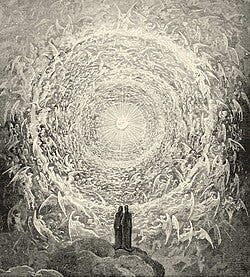


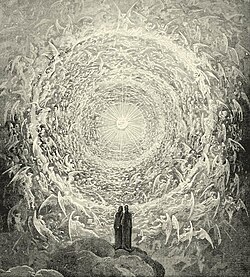
¹²⁵Secularization seems like a trajectory of eventually reliving all theology on this side of finite.
¹²⁶Andersen, Lene Rachel. The Nordic Secret. Nordic Bildung Publishing, 2024: 7 (Kindle Edition; Desktop View).
.
.
.
For more, please visit O.G. Rose.com. Also, please subscribe to our YouTube channel and follow us on Instagram, Anchor, Facebook, and Twitter.
I didn’t read all this. I scrolled around. But I stopped on the few paragraphs about Harrington covering Barfield and Derrida. I haven’t read either.
Ok, so my thought is that we don’t take the “and” in Genesis 1:1 seriously enough. There is an overlap between heaven and earth. This overlap is the precise place where the Bible comes from.
Sidenote (not really a sidenote): I am becoming convinced that ideas are either the language of spirits (who live in heaven) or the poop / overflow of spirits. Every artists knows their ideas come from outside them.
Essentially, if you take a spiritual realm that overlaps and interlocks with earth seriously, then there’s a whole new possibility space for language. This is the direction I’m working on, until I find a better argument or dead-end myself. I also think science, (likely physics first, though maybe biology), will “prove this” before I die, assuming I live to my 80s—so in the next 50 years.
Sorry I didn’t read everything, but those couple paragraphs were just too good :)